The Book · Chapter 12

Extending TOGAF for Continuous and Executable Architecture

The Augmented Enterprise Architect series developed a method built on the Enterprise Architecture Codex, the BMAD operating flow, and the Seed-Validation-Feedback attractor pattern. This essay places that method in relation to TOGAF, the dominant enterprise architecture frame still used in large organizations.

It asks what TOGAF still does well, where its classical practice breaks down under continuous change, and how its central elements need to evolve. Those elements are the Architecture Development Method, the content framework, the architecture repository, and the building blocks. They must change once the repository underneath them is rebuilt as the typed, machine-readable Codex described in earlier essays.

The chapter extends TOGAF rather than replacing it. Read this way, TOGAF becomes the outer frame that holds the continuous and executable architecture of the book together.

1. TOGAF after the document era

TOGAF remains the best-known enterprise architecture frame in large organizations. It offers a shared vocabulary, a development cycle, and a governance posture, together with a disciplined way to relate the business, data, application, and technology architectures of an enterprise. It has survived many methodological fashions because its content is broad enough to accommodate local adaptation. It also codifies what mature enterprise architecture functions have learned to do in practice. None of that is in question.

The main issue is that most common uses of TOGAF freeze it at the level of process description and artifact taxonomy:

  • The Architecture Development Method is often run as a periodic architecture campaign.
  • Deliverables are produced as documents, and principles are stated as prose.
  • Building blocks are listed as conceptual placeholders on diagrams, while governance happens at scheduled review events.

When the enterprise changes only at the pace of these cycles, the approach is acceptable. But the cadence has shifted: cloud pipelines, platform compositions, data product releases, and policy configurations now drive change continuously, with AI-assisted engineering accelerating the loop further. Under that pressure, the gap between architectural documents and the operating system of the enterprise becomes untenable.

We want to build on TOGAF to make it operate as part of an executable system rather than as a commentary.

This reinterpretation rests on a single structural move: the architecture repository, the content framework, and the enterprise continuum that TOGAF describes are given a concrete operational form through the Enterprise Architecture Codex.

  • What TOGAF calls artifacts become typed, versioned, machine-usable objects under the ea.codex/v1 schema family.
  • Where TOGAF describes governance as periodic review, the extended model expresses it as a distributed control loop driven by the Seed-Validation-Feedback attractor.
  • The ADM stops behaving like an event sequence and runs as a continuous decision system.

TOGAF already contains seeds of these moves.

  • The method emphasizes reusable repository content, architecture contracts, and the distinction between architecture building blocks and solution building blocks.
  • The 10th Edition’s modular structure makes tailored application explicit and allows architects to treat parts of the framework as adaptable rather than procedural.
  • Architecture governance is framed as an ongoing function with a formal Architecture Board rather than as a one-time sign-off.

These seeds were always compatible with continuous operation. They were rarely treated that way because the surrounding delivery environment did not require it. It now does.

The contribution of this essay is therefore not to invent a new method. It sets out what changes when each component of TOGAF is rebuilt on a Codex-backed foundation and bound to the delivery and runtime mechanisms through which the enterprise actually operates.

2. Where classical TOGAF practice breaks

Traditional TOGAF practice struggles under continuous change for reasons that are structural rather than procedural. Several of its components break in distinct but related ways and understanding them is the precondition for extending the framework responsibly.

The Architecture Development Method (ADM) is often interpreted as if architecture work were naturally aligned to project mobilization. An architecture vision is produced near the start of an initiative, domain architectures are developed, opportunities and solutions are identified, and a transition architecture is handed to implementation. That cadence made sense when large enterprise programs were the primary vehicle of change. It no longer does in a continuous enterprise, where hundreds of changes land every week across platforms, services, data products, and policy configurations. Each of them touches architecture and none deserves a bespoke ADM campaign. When the cadence of change accelerates without a corresponding change in the architecture operating model, the ADM silently detaches from delivery.

A set of failure patterns appears once that detachment sets in. 

  • Architecture intent becomes separated from execution because principles are too abstract to drive platform, pipeline, or runtime behavior.
  • Architecture contracts are signed and then never referenced again, because they live as prose in document repositories rather than as machine-usable statements bound to delivery artifacts.
  • Delivery teams build shadow heuristics to interpret what architecture actually wants, and those heuristics drift across teams, domains, and vendors.
  • Exceptions accumulate in email threads and ticketing queues rather than as temporal deviations recorded against normative patterns.

Over time, the live system and the architecture record speak about different enterprises.

The governance weakness is more specific. Classical TOGAF governance assumes that review is the moment of control. The Architecture Board convenes, an artifact is presented, compliance is confirmed, and governance is considered done. Continuous enterprises work differently, because control is distributed across design, delivery, platform, and operations. Preventive controls sit inside templates and admission rules. Detective controls live in policy engines and observability pipelines, while proactive controls live inside provisioning APIs. A single periodic review event cannot reach any of these points. When TOGAF governance is implemented only as a review sequence, it becomes ceremonially significant but operationally inert.

The artifact model also becomes insufficient. A principle that states sensitive workloads must remain within specified jurisdictions is not yet a policy. A policy that regulated submission data must remain in European regions is not yet a decision. A decision to use a specific paved-road platform is not yet a specification. A specification is not yet a control. Each of these stages matters. TOGAF names several of them and distinguishes principles, requirements, and architectural contracts, but it rarely forces the distinction to be maintained operationally. In many programs the layers collapse into a single prose narrative, which is then unable to drive either automated controls or continuous conformance.

Building blocks suffer a similar reduction. In many TOGAF implementations, architecture and solution building blocks are treated as conceptual placeholders on a diagram. A modern building block that matters operationally carries a schema and an allowed parameter range. It declares its invariants and the elements it composes. It states a selection rule and a lifecycle position. It is selectable by delivery tooling, referenceable by policy, and observable at runtime. Without that richness, building blocks describe architecture rather than participate in it.

There is also a quieter weakness in how requirements are treated. TOGAF places Requirements Management at the center of the ADM, which is structurally correct. Yet in many organizations requirements circulate through a tool chain that is weakly connected to the architecture repository. Requirements map imperfectly to principles, principles to policies, policies to decisions, and decisions to delivery. When the chain breaks anywhere, the architecture function loses its ability to show continuity between what the business asked for and what the platform actually does.

None of this invalidates TOGAF. It exposes the cost of treating TOGAF as a document method when the enterprise now operates through programmable platforms.

The framework remains valuable precisely because it defines the categories of artifact and governance that a continuous system needs. What must change is the substrate: TOGAF content must live in a form that both architects and delivery systems can consume.

3. The Codex as the living TOGAF repository

The simplest way to state the reinterpretation is this.

The Architecture Repository, the Content Framework, and the Enterprise Continuum that TOGAF describes must be given operational form through the Enterprise Architecture Codex. The Codex is not a replacement for these TOGAF constructs. It is the substrate that makes them executable.

The Architecture Repository in TOGAF is defined as the structured store of architectural outputs, including the content framework, the standards information base, reference models, and governance logs. In most organizations it is implemented as a document library or an EA tool catalog. That form is adequate for human inspection but inadequate for machine consumption. The Codex gives the same structure a typed, versioned, queryable foundation under the ea.codex/v1 schema family. Every category that TOGAF treats as a deliverable becomes a first-class object in the Codex:

  • Principles, policies, design decisions, and architecture specifications carry schemas.
  • Controls, building blocks, reference models, and evidence are versioned alongside them.

Each object has an identifier, a lifecycle, and explicit relationships to the others. Human-readable views can still be rendered when needed. The primary representation is one that delivery platforms, policy engines, and AI assistants can all read without translation.

The Content Framework benefits in a similar way. TOGAF defines categories of artifact such as principles, requirements, architecture definitions, roadmaps, and governance artifacts. When these categories are made explicit in the Codex metamodel, they stop being labels on documents and become types with constraints:

  • A principle carries a scope, an owner, a half-life, and a set of policies that realize it.
  • A policy has a precise target, an enforcement point, and an evidence requirement.
  • A decision has a context, alternatives considered, a rationale, and a binding to controls.
  • An architecture specification has a classification tier, interfaces, invariants, and required evidence.

These types allow the TOGAF artifact taxonomy to become an operational specification language rather than an inventory of document names.

The Enterprise Continuum changes similarly. TOGAF describes it as the conceptual structure through which generic reference models are progressively specialized into context-specific architectures, from foundation through common systems, industry, and organization-specific layers. This structure is naturally expressed as a semantic classification in the Codex. A building block can be marked as a foundation pattern, as an industry-specific variation, as an organization-specific instance, or as a deprecated candidate. Codex relationships then make the progressive specialization explicit. An architect selecting a pattern for a regulated domain can trace upwards to the reference models it derives from and downwards to the instances that realize it.

What was once a conceptual taxonomy becomes a navigable structure.

Real-world implementations have been moving in this direction for some time, although not always under TOGAF terminology.

The Open Group’s guidance for the 10th Edition explicitly encourages tailoring the framework for agile and digital contexts. The modular separation between the ADM and the Content Framework allows organizations to adapt each independently. ArchiMate is The Open Group’s modeling language paired with TOGAF. It has added concepts for strategy, motivation, implementation, and migration so that architecture descriptions can carry the semantic richness needed for continuous governance.

Platforms such as:

  • Backstage show what happens when this structure lives close to delivery. Metadata files stored alongside code are harvested into a catalog of software entities, ownership, and relationships.
  • Crossplane compositions demonstrate that reusable abstractions can be bound to concrete managed resources as typed objects rather than prose guidance.

None of these platforms is TOGAF-branded, yet each illustrates what the TOGAF repository becomes once its content is made machine-usable.

The practical implication is that the Architecture Repository, the Content Framework, and the Enterprise Continuum can be preserved in name and purpose while being rebuilt on a different substrate.

The architect still works with principles, requirements, building blocks, and reference models. These objects now have schemas rather than only narratives. They are versioned rather than only dated. They are referenced by systems rather than only read by humans. Every later extension of TOGAF in this essay depends on this move.

4. Recasting the ADM as a continuous decision system

With the Codex in place as the operational repository, the Architecture Development Method can be reinterpreted without being replaced. Each phase retains its analytical purpose. What changes is the cadence at which it runs and the form in which its outputs persist.

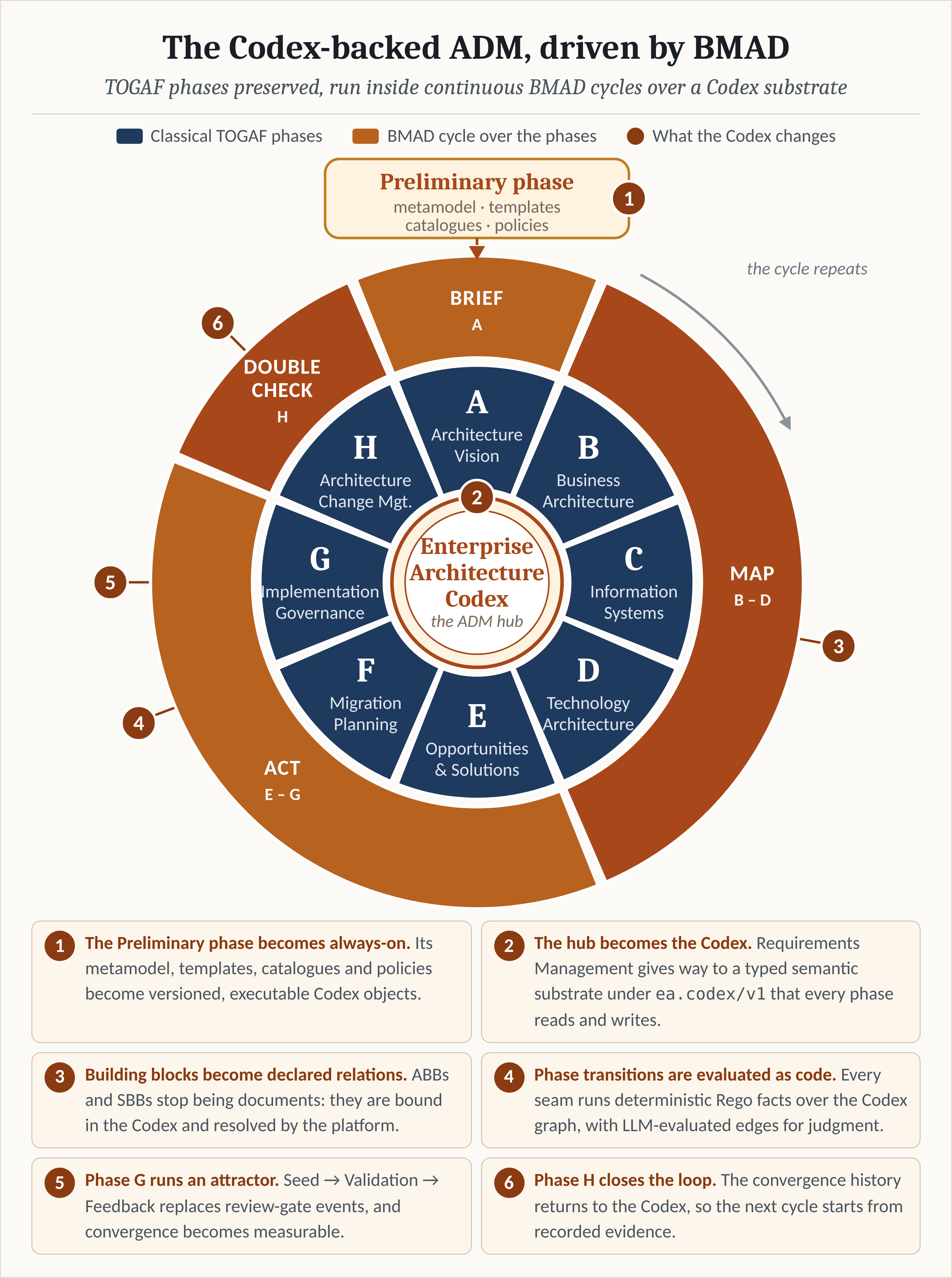
Figure 1 shows the recast structure:

  • The classical ADM phases are preserved at the center.
  • The Codex sits at the hub, and the BMAD operating flow wraps the wheel as the architect’s continuous cycle.
  • Specific additions introduced by the Codex substrate are marked at the points on the wheel where they take effect.

The Codex-backed TOGAF ADM with BMAD operating cycle

Figure 1: The Codex-Backed ADM driven by BMAD: classical TOGAF phases preserved, run inside continuous BMAD cycles over a Codex semantic substrate.

  • The Preliminary Phase stops behaving like an initialization exercise. It becomes the enterprise’s always-on architecture operating system. Its job is to define the metamodel choices and naming rules that the Codex will enforce. Beyond that, it sets the repository structure, the tailoring decisions, and the capabilities required to run the method. In the extended model, Preliminary work is embodied in the Codex schema itself, in the catalogs of approved building blocks, in the policy libraries, and in the platform services that expose them. This phase is never really finished. It is the ground on which everything else operates, and it is maintained as a product rather than reset for each initiative.
  • Architecture Vision becomes a scoped change hypothesis attached to a capability slice. The vision still matters, because enterprise change without direction degenerates into local optimization. Its function becomes more precise, however. It frames intent, names the affected capabilities, identifies the policies and prior decisions that apply, sets measurable success criteria, and indicates the expected building block footprint. It does not invent an architecture. It opens a Codex-backed change packet into which architecture work will flow.
  • The Business, Data, Application, and Technology Architecture phases remain distinct analytical lenses. Their sequence becomes less rigid in a continuous system since they operate concurrently on the same change packet, each producing contributions to a shared design decision record. The output of each phase is no longer a separate document and each contribution lives in the Codex as a typed entry. Capability mappings sit alongside data product specifications, service contracts, and technology building block selections, with explicit constraints that bind them together. The coherence among these contributions is verified continuously by the Codex itself, which refuses combinations that violate invariants.
  • Opportunities and Solutions becomes the phase in which candidate solution building blocks are matched to architecture building blocks, and in which capacity, cost, and lead-time implications are resolved. Under the extended model, this phase is supported by the Codex’s catalog of solution building blocks, each with its declared interfaces, constraints, and operational maturity. A matching that would have required days of workshops in the classical model can often be narrowed to a small decision surface, because most of the reasoning has been pre-encoded.
  • Migration Planning produces a transition architecture that is itself a Codex object rather than a slide deck. The transition architecture names the initial state, the target state, the sequence of intermediate states, and the dependencies among them. Each state references typed artifacts that exist or will exist in the Codex. Project planning tools consume this transition architecture as input rather than rebuilding it in their own notation.
  • Implementation Governance shifts from episodic review to policy-backed conformance management. The normal path is encoded across several control surfaces: templates and provisioning APIs paved the way at design time, CI/CD gates and policy engines enforce conformance during delivery and runtime admission rules close the loop in production. Architecture review focuses on exceptions and on the design of the rules themselves, while conformance evidence accumulates automatically as part of delivery rather than being manufactured for audit.
  • Architecture Change Management becomes the closure of the control loop. Several sources of feedback flow back into the Codex through the attractor’s convergence history. Delivery metrics and runtime conformance data describe how the system is behaving. Incident patterns and exception frequency surface where the rules are wrong or where the system is drifting. Control failures and adoption friction reveal where the architecture is misaligned with how teams actually work. Each of these inputs informs the next round of design decisions and the next iteration of the metamodel itself.
  • Requirements Management sits across all these phases in TOGAF, which is structurally correct. What changes is that requirements flow through the same Codex substrate as everything else. A requirement carries a stable identifier, links to the principles it expresses, the policies that constrain it, the decisions that resolve it, the specifications that formalize it, and the controls that observe its conformance in production. The TOGAF intuition that requirements are central is preserved. The mechanism through which they remain central becomes operational rather than ceremonial.

The net effect is that the ADM is recognisable but transformed. Its phases no longer represent milestones in a sequence, but represent continuing functions of a living architecture system, each expressed through the same typed objects in the Codex.

5. Building blocks, contracts, and controls in executable form

The most distinctive feature of TOGAF in day-to-day practice is its building block vocabulary and its notion of an Architecture Contract. Both change materially under the extended model.

An Architecture Building Block must now be typed and semantically rich enough to drive selection and constraint:

  • It carries an explicit purpose and a defined set of interfaces. It declares its invariants and the assumptions it makes about its dependencies.
  • It exposes its variability points and lifecycle state.

A Solution Building Block is then bound to one or more ABBs through declared references rather than implied correspondence. Selection is not a workshop conclusion, but a Codex-mediated act in which the SBB’s declared interfaces, evidence, and operational maturity are matched against the ABB’s invariants and policies. The output is a recorded decision, not a paragraph in a slide deck.

Architecture Contracts become concrete in the same move. Under the extended model, an Architecture Contract is no longer a narrative agreement on deliverables:

  • It defines the required controls and the approved templates.
  • It specifies the variability allowed and the exceptions permitted, together with the deployment policy and the operational evidence expected.
  • It defines the renewal triggers and the change protocol.

A contract framed in this way becomes machine-usable: pipelines can consume it, policy engines can enforce it, and platforms can use it to determine what to provision.

This is also where the graph-with-LLM-edges control structure enters TOGAF. Governance can be expressed as a graph whose nodes are architecture states and whose edges are transitions:

  • Deterministic checks are encoded as Rego facts read from the Codex.
  • Interpretive checks, where judgment is required, are expressed as LLM edge evaluations against the Codex objects.
  • Convergence becomes the explicit acceptance criterion: a transition is approved when both the Rego facts hold and the edge evaluation confirms that the change preserves the relevant invariants.

The Architecture Board’s role moves from event-driven approval toward designing this graph and curating the policies and prompts that animate it.

The extension also clarifies the role of transition architectures. TOGAF treats a transition architecture as a defined intermediate state between the baseline and the target. In the Codex-backed model, each transition state is itself a composition of typed objects. Capability states, building block versions, and active policies sit alongside the control set and the evidence profile. This composition can be diffed against its predecessor and successor, which makes change risk legible in a way that prose transitions never were.

The concept that binds all these together is the design decision. TOGAF mentions design decisions, but it rarely treats them as the central operational artifact of the framework. Every part of architectural work resolves into a recorded decision: ABB selections, SBB bindings, transitions, variability resolutions, and exceptions are each at heart a decision. Decisions are versioned, justified, traceable, and revisable in the Codex. Treating them as first-class objects gives the architecture function the audit surface it has always claimed but rarely produced.

6. ACME Pharma: an ADM-aligned change packet for a regulatory submissions platform

The artifact in Figure 2 is a simplified Codex-backed architecture change packet for a regulatory submissions management service at ACME Pharma. Its role is to become the operational core from which an ADM-style change runs end to end. It carries enough structure to be consumed by delivery platforms, policy engines, and AI assistants, while remaining readable by an enterprise architect.

apiVersion: ea.codex/v1
kind: ArchitectureChangePacket
metadata:
  id: ACP-REG-018
  name: acp-reg-018
  title: Regulatory submissions management service for EU-hosted regulated workloads
  domain: Regulatory Affairs
  status: approved-with-controls
  owners:
    enterpriseArchitect: ea.regulatory@acme.example
    productOwner: submissions-platform@acme.example
    platformOwner: regulated-platform@acme.example

spec:
  intent:                                  # Architecture Vision
    objectiveRef: OBJ-REG-08
    statement: >
      Reduce preparation time for regulated submissions while preserving
      GxP validation, EU data residency, and full traceability of
      submission artefacts from source evidence to regulatory dossier.
    successMeasures:
      - name: submission-preparation-lead-time
        target: "< 15 business days"
      - name: architecture-nonconformance-rate
        target: "< 2% of releases"

  capabilityScope:                         # Business Architecture
    primary:
      - Regulatory Submissions Management
      - Regulatory Document Lifecycle
    related:
      - Identity and Access Management
      - Audit and Evidence Management

  policies:                                # Architecture Principles made enforceable
    - POL-DATA-021: Regulated submission data must remain in EU-approved regions
    - POL-SEC-008: Service-to-service access must use workload identity
    - POL-OPS-015: Production changes require immutable deployment evidence
    - POL-AI-004: No foundation model may process unredacted submission content

  designDecision:                          # Architecture Decision Record
    id: DD-REG-042
    topic: Runtime and delivery pattern for the submissions platform
    context: >
      Service must support validated document ingestion from internal
      systems and external partners, preserve auditability across the
      regulatory dossier lifecycle, and align with validated paved-road
      controls.
    choice: >
      Use the regulated service template on the internal developer
      platform, deploy on the EU-regulated Kubernetes platform,
      provision persistence through the approved PostgreSQL composition,
      and enforce policy through CI/CD checks plus cluster admission
      rules.
    alternatives:
      - bespoke VM-based deployment for regulator-specific submission channels
      - direct ingestion into a general-purpose analytics platform
    rationale: >
      Maximises reuse of validated controls; reduces lead time by using
      pre-approved platform assets; preserves traceability from decision
      to deployment evidence.

  architectureBuildingBlocks:              # ABBs (Content Framework)
    - id: ABB-APP-044
      name: Regulated Document Management Service
    - id: ABB-DATA-019
      name: Regulatory Submission Data Product
    - id: ABB-TECH-027
      name: EU Regulated Container Platform
    - id: ABB-CTRL-012
      name: Immutable Release Evidence

  solutionBuildingBlocks:                  # SBBs (bound realisations)
    - id: SBB-TPL-009
      type: backstage-template
      ref: template://regulated-service-v3
    - id: SBB-PLAT-014
      type: crossplane-composition
      ref: xrd://eu-postgres-validated/v2
    - id: SBB-POL-022
      type: opa-bundle
      ref: policy://regulatory/eu-residency-and-identity/v5
    - id: SBB-OPS-031
      type: kubernetes-admission
      ref: vap://regulated-workload-constraints/v3

  specification:                           # Architecture Specification (attractor seed)
    serviceTier: regulated-critical
    dataClassification: regulated-document-controlled
    regionSet:
      allowed: [eu-west-1, eu-central-1]
      denied: [us-*, ap-*]
    mandatoryInterfaces: [OpenAPI, audit-event-stream]
    requiredEvidence:
      - template-version
      - build-provenance
      - policy-evaluation-report
      - deployment-approval-record
      - validation-test-summary

  controls:                                # Implementation Governance (validation harness)
    - designTime:approved-template-required
    - designTime:prohibited-data-transfer-patterns
    - pipeline:infrastructure-policy-pass
    - pipeline:sbom-generated
    - pipeline:evidence-bundle-complete
    - runtime:admission-policy-region-constrained
    - runtime:workload-identity-required
    - runtime:audit-stream-enabled

  implementationContract:                  # Architecture Contract
    exceptionProcess:
      authority: architecture-review-cell
      validityWindow: "30 days"
      mandatoryCompensatingControls:
        - enhanced-monitoring
        - weekly-conformance-review
    releasePolicy:
      promotionRequires:
        - all-controls-pass
        - no-open-critical-risks
        - named-business-owner-approval

  feedback:                                # Architecture Change Management (convergence)
    telemetry:
      - release-lead-time
      - failed-control-count
      - exception-frequency
      - runtime-policy-violations
    reviewCadence: monthly
    triggersForDecisionReview:
      - repeated-exceptions-over-threshold
      - policy-failure-trend
      - material-platform-change

Figure 2: ACME Pharma Architecture Change Packet (ACP-REG-018): a Codex-backed realization of the TOGAF ADM as a single typed change object.

This packet performs work that a traditional stack of TOGAF deliverables typically fails to do. Each of its sections maps to a classical TOGAF element, but the mapping is operational rather than descriptive:

  • The intent block holds the architecture vision in a form that can be consumed by reasoning agents.
  • The policies block expresses the principles that constrain the change as machine-checkable references rather than narrative aspirations.
  • The design decision block is the architecture decision record made central, with context, choice, alternatives rejected, and rationale.
  • The architecture building blocks and solution building blocks are explicit Codex references.

The specification holds the seed that the attractor pattern will use:

  • The controls and contract sections operationalize governance.
  • The feedback block defines the signals through which the change will be evaluated over its life.

The building block sections make the ABB and SBB distinction operational:

  • The ABBs name reusable abstractions: a regulated document management service, a regulatory submission data product, a regulated container platform, and an immutable release evidence pattern.
  • The SBBs bind those abstractions to concrete realizations: a Backstage template for service creation, a Crossplane composition for the database, an OPA policy bundle for residency and identity rules, and a Kubernetes admission policy for runtime constraints.

Each binding can be evaluated against the ABB’s invariants in the Codex

  • A delivery platform can use these references directly to provision the service.
  • A policy engine can use them to enforce conformance.
  • A reasoning agent can consult them when proposing future changes.

The specification formalizes the chosen path above raw implementation detail but below generic architecture prose. It pins down the service tier and data classification of the workload, fixes the region boundaries within which the workload may run, and names the mandatory interfaces and required evidence.

These statements are precise enough to drive automated conformance, while the contract and feedback blocks bind the same specification to a continuing governance loop.

Seen as a whole, the packet is the TOGAF ADM expressed as a single persistent object:

  • Preliminary work supplies the metamodel and templates that the packet assumes, along with the policy domains and control surfaces it references.
  • The architecture vision is captured in the intent block.
  • Business architecture is reflected in the capability scope, while information systems and technology architecture are realized through the architecture and solution building block sections.
  • Architecture principles take operational form in the policies block.
  • Opportunities and Solutions are resolved in the SBB choices.
  • Migration Planning is implicit in the change packet’s status and release policy.
  • Implementation Governance is encoded in the controls and contract.
  • Architecture Change Management lives in the feedback block.

None of these elements is invented, but each is expressed in a form that delivery and operations can consume directly.

7. What extending TOGAF asks of the architecture function

The change implied by this reinterpretation is not primarily technical. It is a change in how the architecture function works.

The Architecture Board is redirected rather than diminished. In classical TOGAF, the Board’s authority is expressed most visibly at the review event. In an extended TOGAF, that authority is expressed earlier and later in the flow of change. It appears in the design of the metamodel that determines what can be expressed, and in the curation of the decision catalog. It sets the risk thresholds that distinguish automatic conformance from required human judgment, and it governs the exception economy. The Board’s workload redistributes: it spends less time reading submissions and more time shaping the system in which submissions are evaluated.

The Enterprise Continuum becomes a live classification rather than a conceptual poster. Architects categorize building blocks, reference models, and decisions by their position on the continuum, and that categorization is used operationally by the Codex and the platform. A foundation pattern has different governance than an organization-specific variant, and a deprecated candidate triggers refactoring signals. These distinctions existed in TOGAF all along, but they become useful only when they drive behavior.

Methodologically, architecture intake must become continuous rather than event-driven, and decision records must be explicit, versioned, and treated as primary artifacts. Exceptions must be tracked as temporal deviations from normative patterns rather than as forgotten emails. Architecture contracts must be referenced by running systems, and conformance evidence must accumulate automatically as part of delivery. None of this is impossible under classical TOGAF; it is simply not typical practice.

The skill profile of the architect broadens. Architects need stronger command of semantic modeling so that the objects they define remain stable under schema evolution and can carry traceability across domains. Beyond that, the architect must distinguish durable principles from enforceable policies and contextual decisions, and must know which mechanism enforces each. A working familiarity with platform engineering, policy-as-code, and continuous delivery is also required, so that collaboration with the teams that own the control points is grounded in shared concepts rather than translation. Literacy in the specific frameworks that constitute the execution substrate matters too, including ArchiMate for modeling, policy engines for enforcement, catalogs for metadata, and templates for paved roads. None of this turns the architect into an operator. It gives the architect the shared language required to shape the control surfaces that now carry architectural intent.

AI assistance benefits from this extension in a way that classical TOGAF cannot deliver. In a document-era TOGAF environment, AI can summarize artifacts and suggest wording. That is useful but thin. In a Codex-backed TOGAF environment, AI operates against a structured semantic repository. The assistant can propose decisions consistent with existing principles and evaluate whether a proposed change maintains cross-capability invariants. It can suggest solution building blocks that satisfy declared ABB constraints, and draft specifications and controls that conform to the Codex metamodel. Anomalies in decision chains can be flagged before they propagate. Most consequentially, the assistant can serve as the edge evaluator in the governance graph, giving interpretive judgment inside an otherwise deterministic policy flow. Its reasoning remains auditable because every prompt, every output, and every convergence metric is stored as a typed object in the Codex.

There is a cultural consequence as well. Architecture teams accustomed to defending their relevance through central review often find the transition uncomfortable. Review is visible. Curation of a metamodel and a decision catalog is less so. Relevance shifts toward the quality of the system the architect has designed to govern change, rather than toward the conspicuousness of individual approvals. Organizations that recognize this shift early find that architectural authority becomes more rather than less durable, because it is embedded in the operating environment rather than carried on the shoulders of individuals.

8. Risks, limits, and trade-offs

Extending TOGAF in this direction is not free, and several trade-offs deserve explicit acknowledgement.

Modeling cost is the most obvious. Turning architecture information into machine-usable objects requires disciplined semantics, repository design, versioning rules, and governance of the metamodel itself. Over-modeling can paralyze the function. The practical discipline is to model only what is referenced by delivery, controls, or strategic decisions, and to resist the temptation to encode every nuance of every artifact.

Organizational friction is the next concern, because continuous architecture changes power distribution. Review boards lose their monopoly over interpretation, while platform teams gain influence because they own execution pathways. Security and risk functions must reconcile their control catalogs with the architecture control set. The redistribution is often experienced as territorial conflict even when it is objectively beneficial.

The limits of automation also matter. Not every architectural issue reduces to a template or a policy rule. Strategic trade-offs, major sourcing decisions, regulatory interpretation in novel contexts, and socio-technical coupling still require human judgment. A mature extended-TOGAF implementation knows where automation should stop and routes the rest to accountable people. Enterprises that automate what they should deliberate, or deliberate what they should automate, both pay a penalty.

Maintenance burden accumulates over time. Reusable building blocks age, platform assumptions change, policy bundles acquire exceptions, and decision libraries drift from reality if feedback is weak. The architecture function must be resourced to curate these assets as products, with owners, release cadences, and deprecation policies. Without that investment, the Codex degrades into a museum.

Conceptual confusion is a subtler risk. Many organizations claim to pursue architecture as code when what they actually have is infrastructure automation. These are not the same thing. Infrastructure automation implements technical configurations. Extended TOGAF encodes architectural meaning across intent, policy, decision, specification, and control. The former is a precondition for the latter. Collapsing the two produces automation without architecture, and architecture prose dressed as code.

Toolchain integration adds its own pressure. The more architecture reaches into pipelines, platforms, and runtime controls, the more important interface quality becomes. Poor integration produces inconsistent truth, duplicated evidence, and broken traceability. Enterprises that proceed without a clear integration strategy for the Codex, the delivery platform, the policy engine, and the observability stack discover that the extension is only as strong as its weakest join.

None of these risks is fatal, and none is new in kind. Most are familiar to any program that has attempted to modernize enterprise architecture. What is new is that they compound when TOGAF is extended without sufficient operating-model investment. The extension must be sponsored at a level capable of funding the substrate on which it depends.

9. TOGAF as the governing frame of a living architecture system

The failure of many TOGAF programs has not come from having too much structure. It has come from stopping at descriptive structure when the enterprise now requires operational structure.

Extending TOGAF for continuous and executable architecture means preserving the analytical frame and connecting each of its elements to mechanisms that can observe, evaluate, and influence the live system.

TOGAF remains valuable because it gives enterprise architecture a coherent frame spanning method, governance, content, and reuse. Under extension:

  • The repository, content framework, and continuum are rebuilt on a Codex substrate, and the ADM phases become continuing functions rather than milestones.
  • Building blocks become typed and selectable, while contracts become executable.
  • Governance becomes a distributed control loop driven by the Seed-Validation-Feedback attractor.

TOGAF then stops being a heavy method competing with agile delivery and becomes the shared frame through which continuous and executable architecture is organized.

This extension places TOGAF in its proper relation to the other pillars of the book:

  • BMAD supplies the operating flow that structures architectural work.
  • The Seed-Validation-Feedback attractor supplies the execution loop through which specifications become systems.
  • The graph-with-LLM-edges control structure supplies the governance mechanism that preserves human accountability at the right altitude.
  • Software Product Lines supply the reuse and variability logic that makes industrialized architecture possible.
  • The Enterprise Architecture Codex is the semantic substrate on which all of these cohere under a single schema family.

TOGAF becomes the enterprise-level grammar that organizes their contributions without constraining their internal mechanisms.

The practical conclusion is: The future of TOGAF is not as a larger collection of documents, nor as a defensive heritage artifact of the enterprise architecture profession. Its future is as the governing frame of a living architecture system, grounded in a Codex that holds enterprise semantics. Design decisions convert intent into operational choice. Specifications and controls steer continuous change, and feedback keeps the whole system honest.

10. Sources