What the chapter covers
10 sections, in order.
- 12.1 TOGAF after the document era
- 12.2 Where classical TOGAF practice breaks
- 12.3 The Codex as the living TOGAF repository
- 12.4 Recasting the ADM as a continuous decision system
- 12.5 Building blocks, contracts, and controls in executable form
- 12.6 ACME Pharma: an ADM-aligned change packet for a regulatory submissions platform
- 12.7 What extending TOGAF asks of the architecture function
- 12.8 Risks, limits, and trade-offs
- 12.9 TOGAF as the governing frame of a living architecture system
- 12.10 Sources
Figures, tables and listings
1 figure · 1 code listing
Reproduced in full, in the order they appear in the published chapter. The reasoning that connects them is in the book.
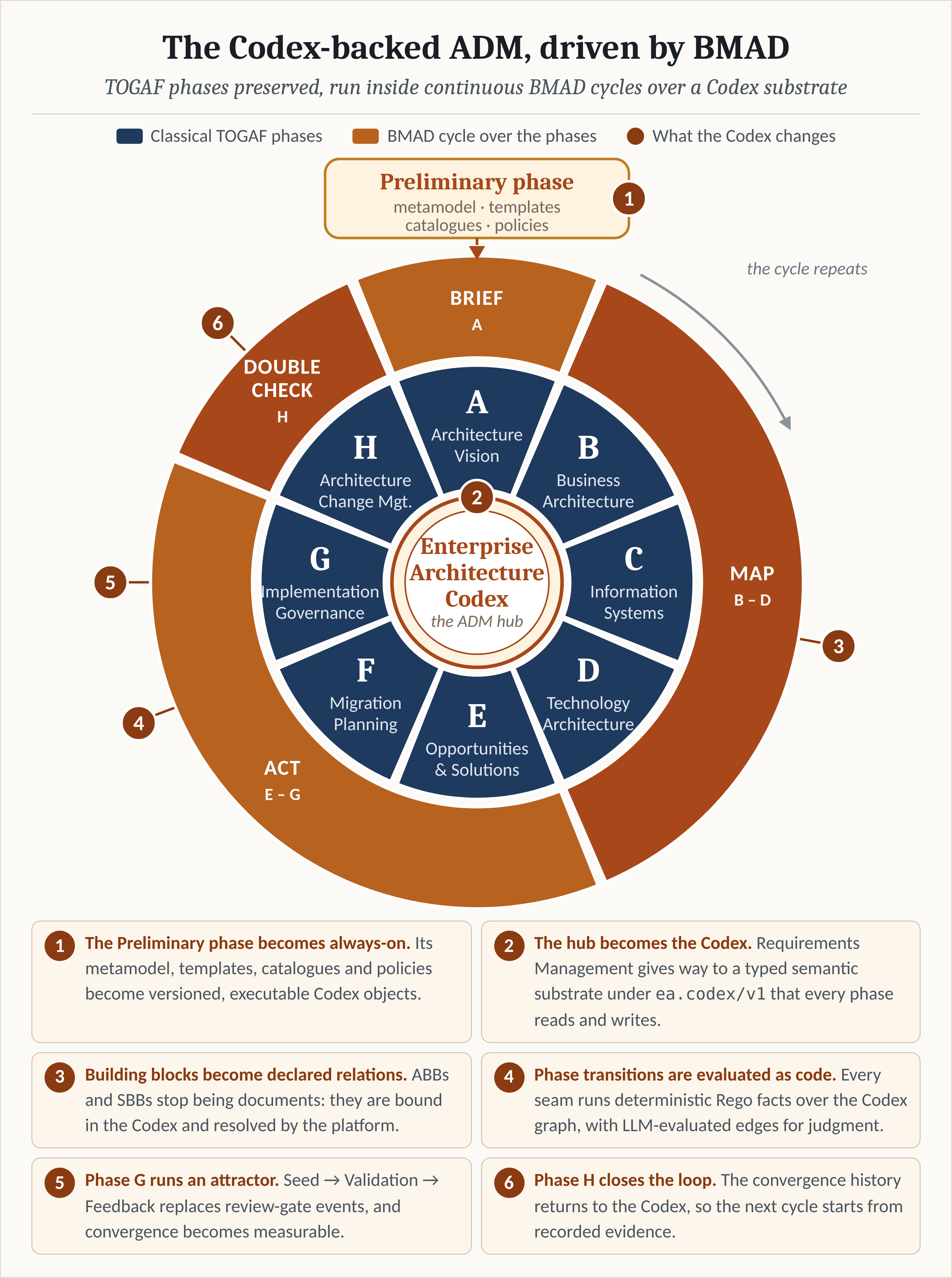
Figure 12.1: The Codex-Backed ADM driven by BMAD: classical TOGAF phases preserved, run inside continuous BMAD cycles over a Codex semantic substrate.
apiVersion: ea.codex/v1
kind: ArchitectureChangePacket
metadata:
  id: ACP-REG-018
  name: acp-reg-018
  title: Regulatory submissions management service for EU-hosted regulated workloads
  domain: Regulatory Affairs
  status: approved-with-controls
  owners:
    enterpriseArchitect: ea.regulatory@acme.example
    productOwner: submissions-platform@acme.example
    platformOwner: regulated-platform@acme.example
spec:
  intent:                                  # Architecture Vision
    objectiveRef: OBJ-REG-08
    statement: >
      Reduce preparation time for regulated submissions while preserving
      GxP validation, EU data residency, and full traceability of
      submission artefacts from source evidence to regulatory dossier.
    successMeasures:
      - name: submission-preparation-lead-time
        target: "< 15 business days"
      - name: architecture-nonconformance-rate
        target: "< 2% of releases"
  capabilityScope:                         # Business Architecture
    primary:
      - Regulatory Submissions Management
      - Regulatory Document Lifecycle
    related:
      - Identity and Access Management
      - Audit and Evidence Management
  policies:                                # Architecture Principles made enforceable
    - POL-DATA-021: Regulated submission data must remain in EU-approved regions
    - POL-SEC-008: Service-to-service access must use workload identity
    - POL-OPS-015: Production changes require immutable deployment evidence
    - POL-AI-004: No foundation model may process unredacted submission content
  designDecision:                          # Architecture Decision Record
    id: DD-REG-042
    topic: Runtime and delivery pattern for the submissions platform
    context: >
      Service must support validated document ingestion from internal
      systems and external partners, preserve auditability across the
      regulatory dossier lifecycle, and align with validated paved-road
      controls.
    choice: >
      Use the regulated service template on the internal developer
      platform, deploy on the EU-regulated Kubernetes platform,
      provision persistence through the approved PostgreSQL composition,
      and enforce policy through CI/CD checks plus cluster admission
      rules.
    alternatives:
      - bespoke VM-based deployment for regulator-specific submission channels
      - direct ingestion into a general-purpose analytics platform
    rationale: >
      Maximises reuse of validated controls; reduces lead time by using
      pre-approved platform assets; preserves traceability from decision
      to deployment evidence.
  architectureBuildingBlocks:              # ABBs (Content Framework)
    - id: ABB-APP-044
      name: Regulated Document Management Service
    - id: ABB-DATA-019
      name: Regulatory Submission Data Product
    - id: ABB-TECH-027
      name: EU Regulated Container Platform
    - id: ABB-CTRL-012
      name: Immutable Release Evidence
  solutionBuildingBlocks:                  # SBBs (bound realisations)
    - id: SBB-TPL-009
      type: backstage-template
      ref: template://regulated-service-v3
    - id: SBB-PLAT-014
      type: crossplane-composition
      ref: xrd://eu-postgres-validated/v2
    - id: SBB-POL-022
      type: opa-bundle
      ref: policy://regulatory/eu-residency-and-identity/v5
    - id: SBB-OPS-031
      type: kubernetes-admission
      ref: vap://regulated-workload-constraints/v3
  specification:                           # Architecture Specification (attractor seed)
    serviceTier: regulated-critical
    dataClassification: regulated-document-controlled
    regionSet:
      allowed: [eu-west-1, eu-central-1]
      denied: [us-*, ap-*]
    mandatoryInterfaces: [OpenAPI, audit-event-stream]
    requiredEvidence:
      - template-version
      - build-provenance
      - policy-evaluation-report
      - deployment-approval-record
      - validation-test-summary
  controls:                                # Implementation Governance (validation harness)
    - designTime:approved-template-required
    - designTime:prohibited-data-transfer-patterns
    - pipeline:infrastructure-policy-pass
    - pipeline:sbom-generated
    - pipeline:evidence-bundle-complete
    - runtime:admission-policy-region-constrained
    - runtime:workload-identity-required
    - runtime:audit-stream-enabled
  implementationContract:                  # Architecture Contract
    exceptionProcess:
      authority: architecture-review-cell
      validityWindow: "30 days"
      mandatoryCompensatingControls:
        - enhanced-monitoring
        - weekly-conformance-review
    releasePolicy:
      promotionRequires:
        - all-controls-pass
        - no-open-critical-risks
        - named-business-owner-approval
  feedback:                                # Architecture Change Management (convergence)
    telemetry:
      - release-lead-time
      - failed-control-count
      - exception-frequency
      - runtime-policy-violations
    reviewCadence: monthly
    triggersForDecisionReview:
      - repeated-exceptions-over-threshold
      - policy-failure-trend
      - material-platform-change
Figure 12.2: ACME Pharma Architecture Change Packet (ACP-REG-018): a Codex-backed realization of the TOGAF ADM as a single typed change object.