What the chapter covers
12 sections, in order.
- 17.1 Where each artifact lives
- 17.2 What the enterprise architect owns
- 17.3 The lifecycle of a Codex object
- 17.4 The project step by step
- 17.5 The project roles
- 17.6 How the roles compose
- 17.7 Responsibility contracts as a second reading
- 17.8 The ACME Pharma responsibility chain
- 17.9 Where this model breaks
- 17.10 Adopting the model in stages
- 17.11 Conclusion
- 17.12 Sources
Figures, tables and listings
2 figures · 2 tables · 1 code listing
Reproduced in full, in the order they appear in the published chapter. The reasoning that connects them is in the book.
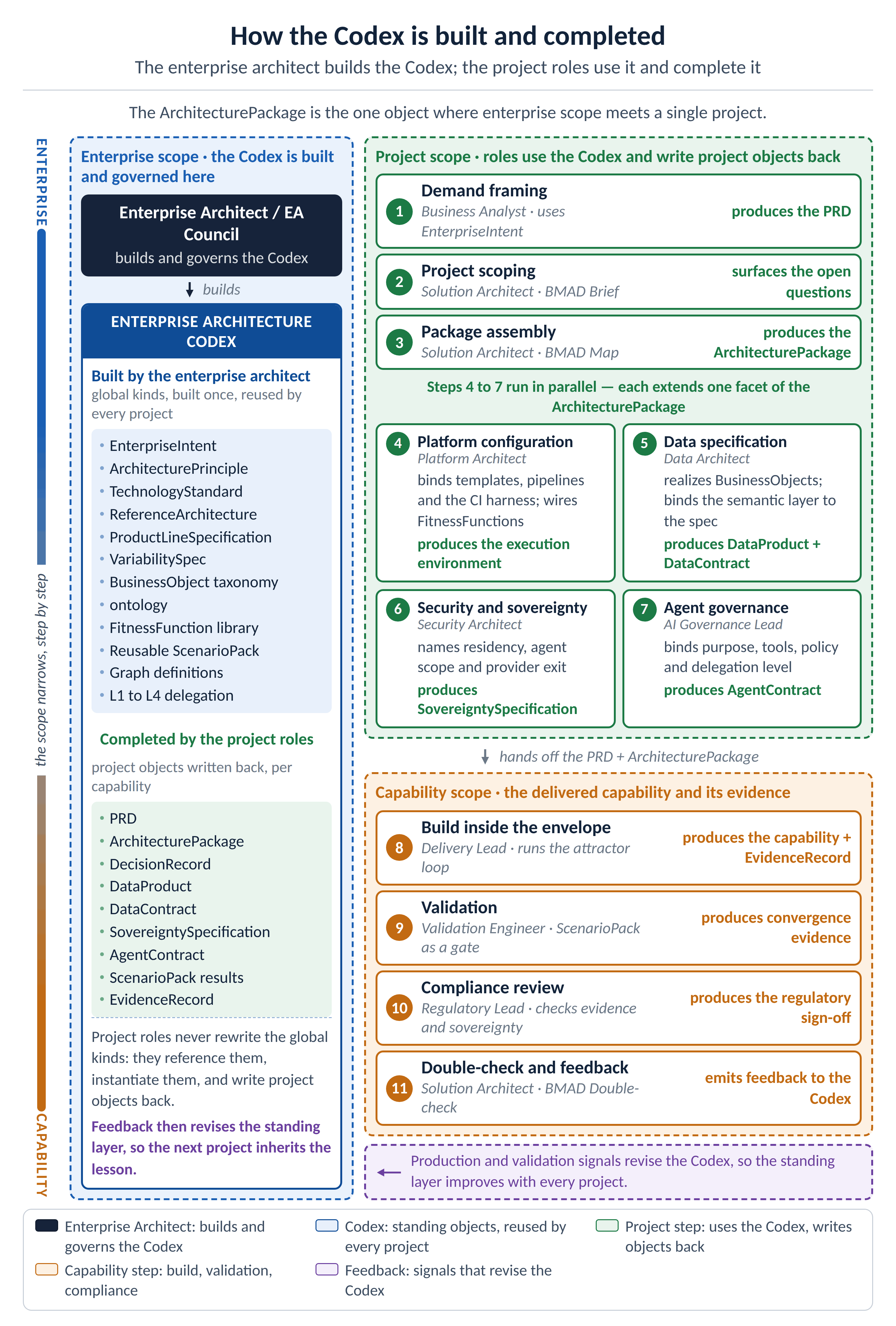
Figure 17.1: The Codex across enterprise, project, and capability scopes, with the eleven project steps and their roles in the project band.
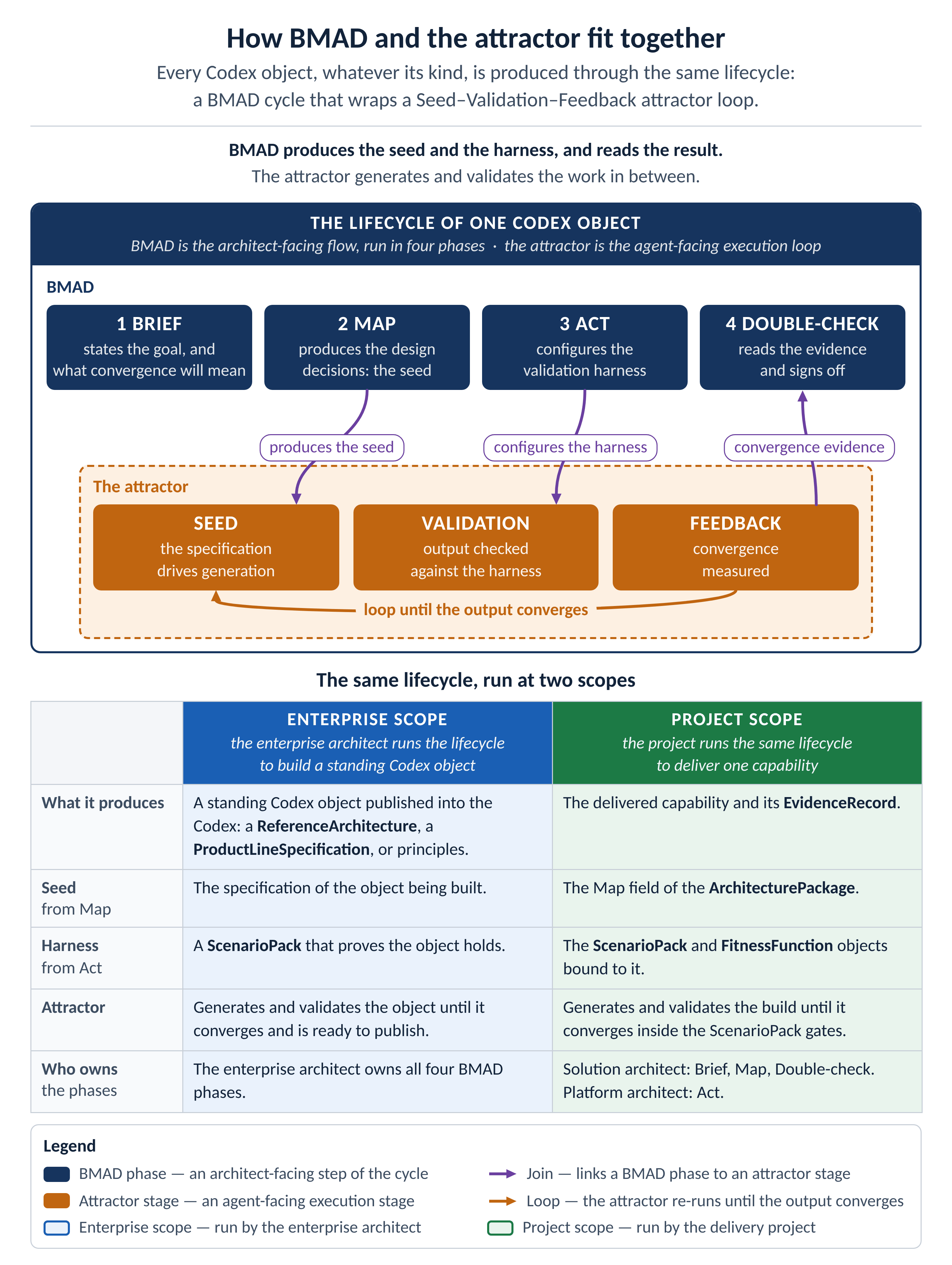
Figure 17.2: BMAD as the architect-facing flow, with the Seed-Validation-Feedback attractor nested inside it as the agent-facing loop.
| Role | Primary Codex objects consumed | Primary Codex objects produced | BMAD phase / attractor relationship |
|---|---|---|---|
| Business analyst | EnterpriseIntent, capability map | PRD | Before Brief; defines demand |
| Enterprise architect | Portfolio feedback signals | Standing global layer (ArchitecturePrinciple, TechnologyStandard, ReferenceArchitecture, ProductLineSpecification) | Outside the project cycle; supplies the asset base |
| Solution architect | EnterpriseIntent, ProductLineSpecification, ReferenceArchitecture, PRD | ArchitecturePackage, DecisionRecord | Brief, Map, Double-check; the Map field is the seed |
| Platform architect | ArchitecturePackage, TechnologyStandard, FitnessFunction library, reusable ScenarioPack | Bound solution building blocks, pipelines, harness in CI | Act; configures the validation harness |
| Data architect | BusinessObject taxonomy, enterprise ontology | BusinessObject realizations, DataProductContract, DataContract, semantic bindings | Act; data specifications inside the envelope |
| Security and sovereignty architect | ArchitecturePackage, EnterpriseIntent, ArchitecturePrinciple | SovereigntySpecification, security FitnessFunction objects | Contributes constraint to Map, enforcement to Act |
| AI and agent governance lead | ArchitecturePackage, SovereigntySpecification, DataProductContract | AgentContract | Contributes a seed to Map |
| Delivery and engineering lead | PRD, ArchitecturePackage | Working capability, EvidenceRecord | Operates the attractor execution |
| Quality and validation engineer | ScenarioPack, AgentContract thresholds | Convergence evidence, controlled EvidenceRecord | Owns the Validation stage of the attractor |
| Compliance and regulatory lead | EvidenceRecord, ScenarioPack results, SovereigntySpecification | Regulatory sign-off, remediation findings | Consumes evidence ahead of Double-check |
| Responsibility contract | Primary role carrier | Main Codex objects | Gate | Evidence |
|---|---|---|---|---|
| Demand | Business analyst | PRD, EnterpriseIntent | Demand framing accepted by solution architect | Decision-ready PRD bound to EnterpriseIntent |
| Architecture | Solution architect | ArchitecturePackage, DecisionRecord | Brief and Map approval by EA Council | Convergence report against ArchitecturePackage |
| Execution | Platform architect and delivery lead | FitnessFunction, RegoPackage, Scenario Pack | Pipeline gate blocks non-conforming change | Pipeline EvidenceRecord per pull request |
| Semantic and data | Data architect | DataProductContract, DataContract, BusinessObject | Contract validation passes against data products | Conformance run on each data product release |
| Trust and autonomy | Security architect and AI governance lead | SovereigntySpecification, AgentContract, ToolAccessPolicy | Sovereignty and agent autonomy review | Sovereignty and agent EvidenceRecord |
| Evidence | Validation engineer and compliance lead | EvidenceRecord, ScenarioPack, PolicyConstraint | Validation harness and regulatory sign-off | Audit-ready evidence stream into Codex |
apiVersion: ea.codex/v1
kind: ArchitecturePackage
id: ACP-ARC-PV-INTAKE-V1
name: acme-pharma-pv-intake-architecture-package
domain: pharmacovigilance
status: approved
version: "1.0"
brief:
  intent:
    outcome: AI-assisted adverse-event intake without autonomous medical-validity decisions
    value: Reduce manual intake effort while preserving patient-safety obligations
  capabilityScope:
    - pharmacovigilance.adverse-event-intake
  decisionObligations:
    - ACP-DEC-PV-AGENT-DATA-ACCESS-001
    - ACP-DEC-SAP-API-001
map:
  familyBinding:
    productLine: ACP-PLS-REGULATED-AI-INTAKE-001
    variant: pv-intake
  designDecisions:
    - id: ACP-DEC-PV-AGENT-DATA-ACCESS-001
      topic: Agent access to pharmacovigilance data
      option: Approved data-product access only
      rationale: Prevent direct writes or uncontrolled access to safety systems
act:
  codexAssets:
    - kind: AgentContract
      ref: ACP-AGT-PV-TRIAGE-V1
    - kind: ScenarioPack
      ref: ACP-SCN-PV-INTAKE-V1
    - kind: FitnessFunction
      ref: ACP-FF-AGENT-FORBIDDEN-ACTIONS-001
    - kind: DataProductContract
      ref: ACP-DPC-PV-CASE-EVIDENCE-V1
    - kind: SovereigntySpecification
      ref: ACP-SOV-EU-PII-V1
  # x-roleAssignments and x-responsibilityContracts are illustrative extensions,
  # not canonical fields of the published v1.1.0 ArchitecturePackage schema.
  # The role view maps individual roles to the typed Codex kinds and BMAD phases.
  # The contract view maps owner boundaries and produced artifacts.
  x-roleAssignments:
    solutionArchitect:
      codexKinds: [ArchitecturePackage, DecisionRecord]
      bmadPhases: [Brief, Map, DoubleCheck]
    platformArchitect:
      codexKinds: [FitnessFunction, RegoPackage]
      operationalArtifacts: [pipelineBinding, validationHarness]
      bmadPhases: [Act]
    dataArchitect:
      codexKinds: [DataProductContract, DataContract, BusinessObject]
      bmadPhases: [Act]
    securityArchitect:
      codexKinds: [SovereigntySpecification, FitnessFunction]
      bmadPhases: [Map, Act]
    aiGovernanceLead:
      codexKinds: [AgentContract, ToolAccessPolicy, AgentMemoryPolicy]
      delegationLevel: L2
      bmadPhases: [Map]
    deliveryLead:
      codexKinds: [EvidenceRecord]
      activities: [build, integrate, observe]
      bmadPhases: [Act, Attractor]
    validationEngineer:
      codexKinds: [EvidenceRecord, ScenarioPack]
      bmadPhases: [Attractor.Validation]
    complianceLead:
      codexKinds: [EvidenceRecord, PolicyConstraint]
      activities: [regulatoryMapping, signOff]
      bmadPhases: [PreDoubleCheck]
  x-responsibilityContracts:
    demand:
      owner: ba.pv@acmepharma.eu
      produces: [PRD]
    architecture:
      owner: sa.pv@acmepharma.eu
      produces: [ArchitecturePackage, DecisionRecord]
    execution:
      owner: platform.pv@acmepharma.eu
      produces: [pipelineBinding, validationHarness]
      blockingMode: deny
    semanticData:
      owner: data.pv@acmepharma.eu
      produces: [DataProductContract, DataContract]
    trustAutonomy:
      owner: ai-governance@acmepharma.eu
      produces: [AgentContract, ToolAccessPolicy]
      delegationLevel: L2
    evidence:
      owner: validation.pv@acmepharma.eu
      produces: [EvidenceRecord, convergenceReport]
doubleCheck:
  evidence:
    - evidenceSinkRef: ACP-EVD-PV-INTAKE-STREAM
      scenarioPackRef: ACP-SCN-PV-INTAKE-V1
      acceptance: convergence-required
Figure 17.3: ArchitecturePackage extended with x-roleAssignments (role view) and x-responsibilityContracts (contract view).