Architecture is entering a new phase.
For decades, enterprise architecture has tried to create coherence across strategy, business structure, applications, platforms, data, and governance. That mission remains valid, but the conditions have changed. Enterprises now operate through continuous delivery, software-intensive operating models, cloud platforms, data ecosystems, and AI-enabled decision systems. In such a context, architecture cannot remain a static representation of an organization that is already moving. It must become part of the mechanism by which the organization moves.
That is the central claim of this book. The chapters have made the case, layer by layer, that architecture must become more semantic, more explicit, more constrained, and more executable. It must define not only what the enterprise is, but how intent is translated into systems, how design choices are governed, how evidence is gathered, and how change is carried safely into execution.
What follows is a synthesis of the argument, intended both as a recapitulation for readers who have followed the chapters and as a fifteen-minute path through the central thesis for senior leaders coming to it for the first time. It rests on three figures developed across the book: the layered structure of the Enterprise Architecture Codex, the dark-factory operating model that runs on top of it, and the maturity path along which an enterprise reaches that operating model. After stating the architectural problem and the central thesis, the synthesis takes each of the four Parts in turn and closes on the cumulative claim.
1. The architectural problem
Enterprise architecture has had real successes in giving large organizations a vocabulary, a structure, and a governance posture for technology landscapes that would otherwise have evolved by improvisation. Its instruments shaped how enterprises described, planned, and reasoned about their systems for nearly four decades. The operating environment has since shifted in ways that strain those instruments. Continuous delivery, cloud-native platforms, data-intensive operations, regulatory complexity, and AI-enabled engineering have moved the cadence of change beyond what periodic architecture campaigns can address. The gap between what architecture describes and what the enterprise does has widened, and AI consumption raises the cost of that gap further by exposing every weakness of semantic discipline, decision clarity, and access governance.
The traditional EA failure mode is now familiar. A principle is published, a target state is drawn, a review board is convened, and an artifact is produced. Meanwhile the enterprise lands hundreds of changes a week through pipelines, platform compositions, data product releases, and policy configurations. Each of these touches architecture; almost none consults it. The instruments do not fail because they are wrong. They fail because they are too slow, too coarse, and too far from execution to govern continuous change. The result is an architecture practice that produces commentary rather than control, and a delivery system that becomes architecturally illegible to the function nominally responsible for it.
AI raises the stakes rather than rescuing them. An AI-rich enterprise is one in which retrieval crosses semantic boundaries, agents take actions on behalf of business processes, and pipelines reason over data that was never specified to be reasoned over. Where the enterprise vocabulary is unstable, the system retrieves the wrong material. Where the data landscape is weakly governed, agents mix draft content with approved content. Where authority is unclear, agents act beyond their mandate. Architecture is no longer one input among many to delivery. It is the substrate on which AI either operates safely or operates unsafely, and that makes architectural ambiguity expensive in a way it was not before.
The cost is not theoretical. Industry telemetry on AI agent deployments traces roughly half of failures to insufficient governance and weak interoperability of the underlying knowledge structures. The model is not the scarce resource. The structured, machine-readable context that lets the model reason safely over enterprise data is the scarce resource. An architecture function that cannot supply that context, or that supplies it only as descriptive prose, leaves the enterprise unable to scale AI past the pilot stage. This book has treated that as the central architectural problem of the next decade and has proposed a method for solving it.
2. The central thesis and the Codex
The book argues that enterprise architecture must evolve from a periodic, document-centered governance discipline into a continuous, semantic, decision-aware, specification-driven, and executable system integrated with delivery and operations. Architecture must stop being a retrospective description of the enterprise. It must function as an operational mechanism through which the enterprise designs, governs, and executes change.
The structural move that carries this evolution is a chain of explicit transformations running from enterprise intent into operational reality.
- Intent gives the chain its direction.
- Capabilities give it stable business scope.
- Policies impose the constraints under which intent can be pursued.
- Design decisions translate intent and constraint into specific execution choices, which are then formalized as specifications.
- Controls verify conformance at runtime, and feedback updates future decisions in light of what runtime reveals.
The chain reaches downstream into delivery, platform configuration, and runtime enforcement, and reaches upstream into the next round of strategic and architectural decisions. None of these elements is new. What is new is the requirement that they connect mechanically rather than rhetorically.
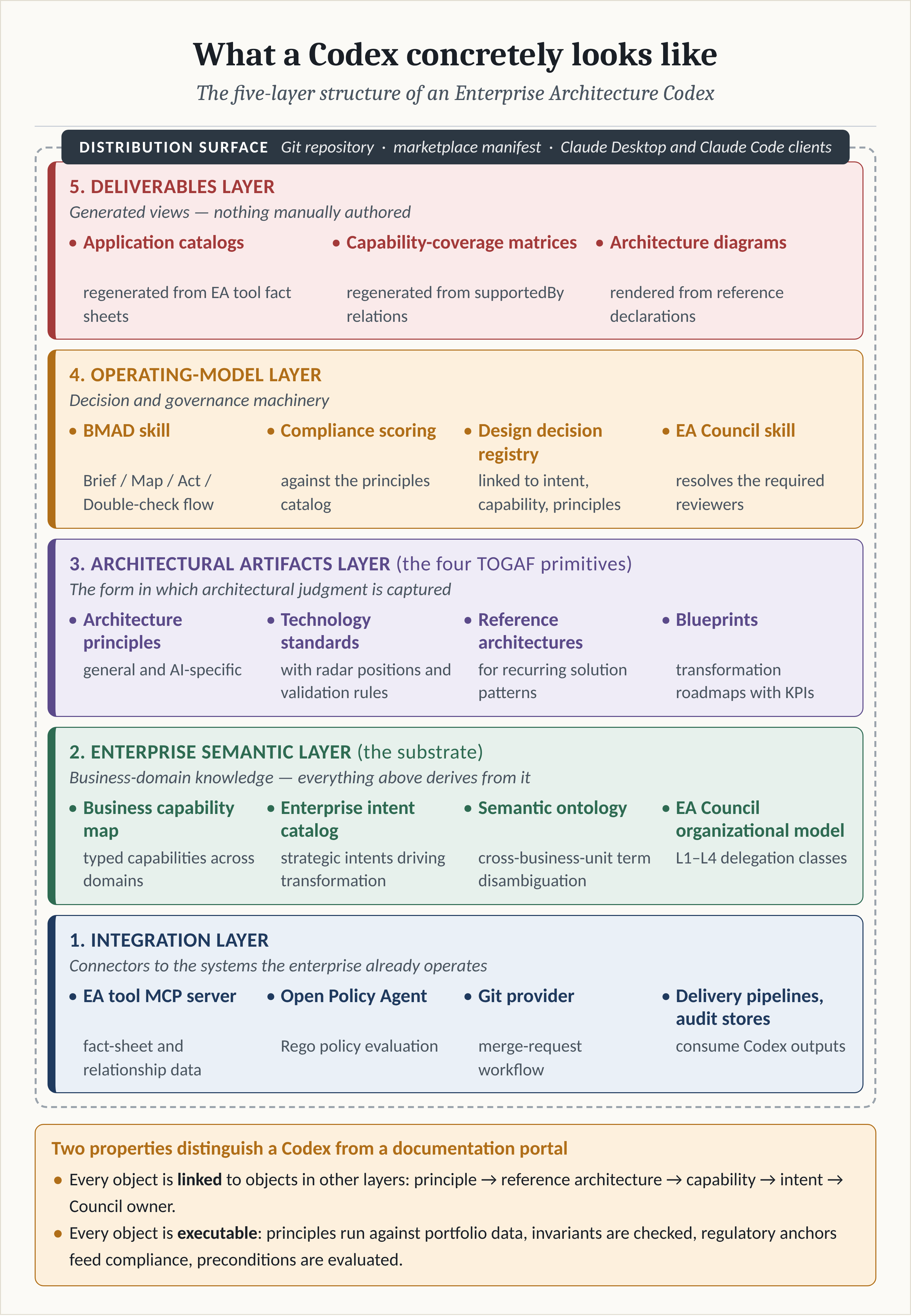
The connective tissue of this chain is the Enterprise Architecture Codex. The Codex is a structured semantic system that holds enterprise meaning, governing policies and decisions, and the specifications and controls that bring those decisions into execution. It holds typed objects under a common schema family, ea.codex/v1, that names the kinds of artifacts the enterprise governs. Figure 1 shows the layered shape the Codex takes once a mature enterprise has built it.

Figure 1: The five-layer structure of an Enterprise Architecture Codex (developed in Chapter 6)
Five layers compose the Codex.
- The integration layer connects to the systems the enterprise already operates: the EA tool, the policy engine, the Git provider, the delivery pipelines and audit stores.
- The semantic layer carries the business-domain substrate from which everything above derives, including the capability map, the intent catalog, the ontology, and the EA Council organizational model.
- The architectural artifacts layer carries the four TOGAF primitives in typed form: principles, technology standards, reference architectures, and blueprints.
- The operating-model layer carries the decision and governance machinery, including the BMAD skill, the compliance scoring rules, the design decision registry, and the EA Council reviewer-resolution skill.
- The deliverables layer carries the generated views that consumers see, with nothing manually authored.
Two properties distinguish a Codex from a documentation portal.
- Every object is linked to objects in other layers, so a principle reaches through reference architectures to capabilities to intent to a Council owner.
- Every object is executable, so principles run against portfolio data and invariants are checked rather than recited.
3. How the book develops the argument
The argument unfolds across four Parts.
- Part I lays the conceptual ground.
- Part II builds the operating model.
- Part III tests the method against the surfaces an architect deals with.
- Part IV runs the whole method through a single regulated enterprise. The Conclusion you are reading is a synthesis of all four.
3.1. Part I: Foundations.
Part I establishes why the traditional model has run out of authority and lays the groundwork the rest of the book operates on. It examines why centralized, document-centered governance no longer keeps pace with the operating cadence of modern enterprises, develops continuous architecture as the response, defines intent-driven architecture as the entry point of the chain, explains why AI consumption raises the cost of architectural ambiguity rather than rescuing the architect from it, applies the method end to end on a SAP Activate and RISE transformation as the opening worked example, and closes with the Enterprise Architecture Codex as the typed-object world the rest of the book operates on.
3.2. Part II: Industrialization and Making It Real.
Part II builds the operating model that turns the method into working machinery. The architecture function automates its own execution by composing BMAD, the architect's operating flow of Brief, Map, Act, and Double-check, with the Seed-Validation-Feedback attractor pattern that runs under architectural control.
The deliverables of architecture, including reference architectures, principles, technology standards and radar, target states, and diagrams, are reframed as seed-driven artifacts produced through attractor loops rather than hand-authored documents.
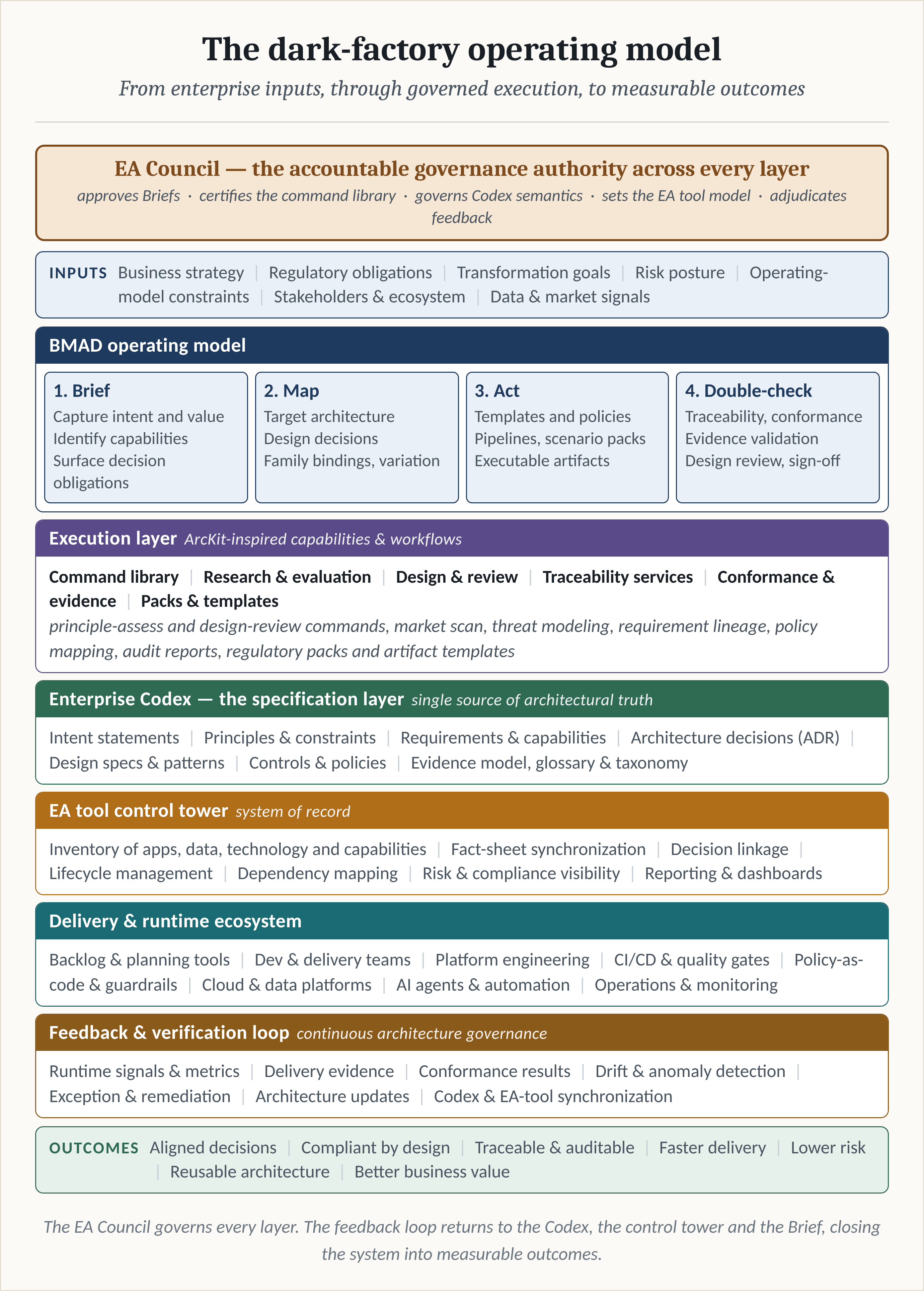
Software Product Line discipline closes Part II as the variability frame that lets the operating model scale across the enterprise portfolio rather than collapse under one-off design. Figure 2 shows how these layers compose into a single accountable system.

Figure 2: The dark-factory operating model: from enterprise inputs through governed execution to measurable outcomes (developed in Chapter 7)
Read top to bottom:
- The EA Council sits as accountable governance authority across every layer, approving Briefs, certifying the command library, governing Codex semantics, setting the EA tool model, defining delivery boundaries, and adjudicating feedback signals.
- The BMAD operating model produces the architectural content the rest of the system consumes.
- The ArcKit-inspired execution layer mechanizes that production through a command library, research and evaluation, design and review, traceability, conformance, and packs and templates.
- The Enterprise Codex is the typed substrate that holds the architectural objects in versioned, governed, machine-readable form.
- The EA tool control tower carries the system of record. The delivery and runtime ecosystem is where the attractor realizes the work, and the feedback loop closes the system into measurable outcomes.
- Enterprise inputs enter on the left; outcomes such as aligned decisions, traceability, faster delivery, and lower risk emerge on the right.
3.3. Part III: Method in Practice.
Part III tests the method against five surfaces an enterprise architect deals with.
Two are internal domains where typed specifications change what governance can mean: AI agent governance through the typed agent contract that binds purpose, semantics, context envelope, tool boundaries, policy, decision inheritance, and trace requirements into one governed unit (Chapter 10), and data governance for agentic consumption through business objects, data products, data contracts, and the semantic layer (Chapter 11).
Three are external pressures the method must absorb without losing coherence: the established TOGAF frame, recast on a Codex-backed substrate without being replaced (Chapter 12); the binding control problem of sovereignty, treated as the capacity to decide, prove, and preserve control over digital action across data residency, agent reasoning, tool invocation, and provider dependency (Chapter 13); and a real recent vendor policy change, the April 2026 SAP API Policy, run through the typed propagation chain end to end and absorbed as a single reviewable pull request that updates decision, principle, standard, fitness function, and surfaced spec deltas in one atomic delta (Chapter 14). Each chapter applies the same Codex-and-attractor machinery to a different stress.
3.4. Part IV: The Integrated ACME Pharma Case.
A regulated pharmaceutical enterprise, ACME Pharma, runs through the body of the book as the worked example, with each of Chapters 1 through 14 developing a focused scenario in that enterprise.
Chapter 15 then takes the same enterprise and runs the whole method through it as one continuous narrative, structured in four sections that mirror the chain: enterprise context, strategy, and intent; the move from intent to architecture specification; design decisions, Codex artifacts, and executable controls; and industrialization, automation, and dark-factory execution. It is the chapter to read when one wants to see how the method holds together end to end in a regulated environment, complementing rather than replacing the focused scenarios that anchor the earlier chapters.
4. What this changes for the architect
The cumulative claim of the book is that enterprise architecture can recover practical authority by becoming structurally precise, semantically explicit, and operationally connected to the mechanisms through which enterprises change. The architect's day-to-day work changes accordingly.
Architecture stops producing documents that wait for review and starts producing typed specifications that flow into delivery, runtime controls, and feedback loops. The architect spends less time enforcing principles in meetings and more time encoding decisions into specifications that platforms enforce automatically. The review event does not disappear. It shifts from being the place where architecture happens to being the place where the seeds of attractor loops are approved. AI agents become objects of architecture rather than threats to it. They receive contracts that bind purpose, semantics, and policy, and they operate within governance graphs rather than autonomously. Data becomes an architectural surface rather than a downstream concern, with business objects governed in the Codex and data contracts as the executable specifications’ platforms enforce. Sovereignty becomes a continuous control problem held in the Codex through specifications and runtime evidence rather than a one-time decision recorded in a contract clause.
The operating model of the architecture function shifts as well. The Architecture Board no longer reviews finished proposals. It sets the seeds and approves the convergence criteria for attractor loops, then reads the validation evidence those loops produce. The relationship with delivery teams changes from advisory to contractual. Teams operate against typed specifications they can validate locally, and architecture is responsible for keeping those specifications coherent across the portfolio. The relationship with platform engineering changes from review to co-production, because the controls that enforce architecture are themselves part of the platform. Time spent in meetings drops. Time spent writing specifications and reviewing convergence histories rises. Architecture becomes a measurable function rather than a judged one.
The skill profile shifts in a corresponding direction. Architects need enough engineering literacy to write specifications that survive contact with delivery, and enough policy discipline to bind decisions to executable controls. They need enough product thinking to treat assets as governed deliverables rather than one-off documents, and enough regulatory awareness to keep the Codex consistent with the obligations the enterprise must satisfy. The architect does not become an engineer, but the boundary between architecture and engineering narrows and is no longer crossed only at handoffs. The architecture function becomes part of the operating system of the enterprise rather than a discipline that comments on it.
5. The path forward
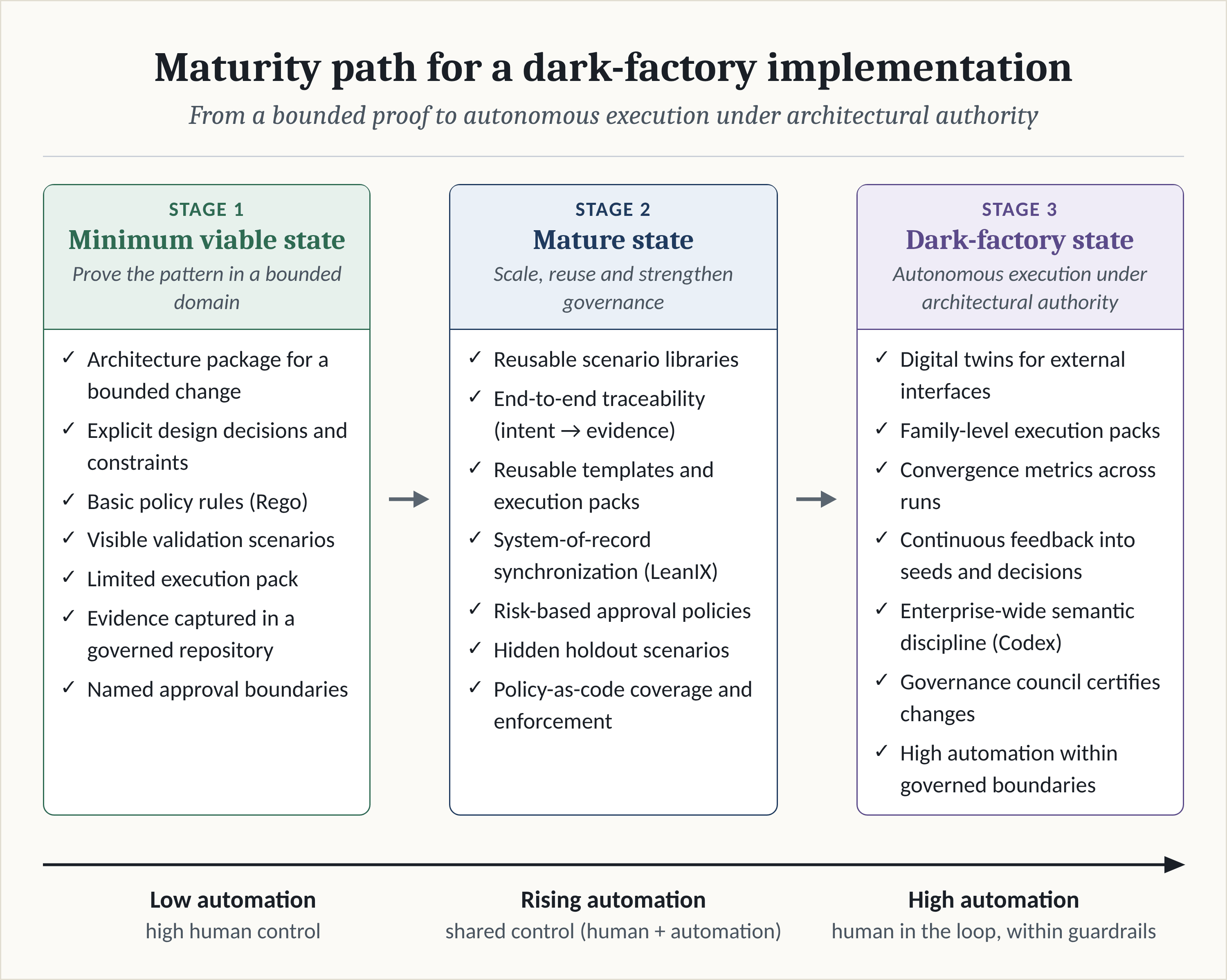
None of this happens at once. The discipline pays off where there is reuse, regulated significance, or large-scale delegated realization, and the operating model is reached in stages rather than declared in a memo. Figure 3 names the three states an enterprise passes through on the way to the full mode.

Figure 3: Maturity path from minimum viable execution to dark-factory operation (developed in Chapter 7)
- The minimum viable state proves the pattern in a bounded domain: an architecture package for one bounded change, explicit design decisions and constraints, basic policy rules in Rego, visible validation scenarios, a limited execution pack, evidence captured in a governed repository, and named approval boundaries.
- The mature state scales the pattern, with reusable scenario libraries, end-to-end traceability from intent to evidence, reusable templates and execution packs, system-of-record synchronization, risk-based approval policies, hidden holdout scenarios, and policy-as-code coverage and enforcement.
- The dark-factory state is autonomous execution under architectural authority: digital twins for external interfaces, family-level execution packs, convergence metrics across runs, continuous feedback into seeds and decisions, enterprise-wide semantic discipline in the Codex, a governance council that certifies changes to the templates and packs, and high automation within governed boundaries.
Each state is a defensible operating point. Not every domain needs to reach the third state, and the architect's task is to choose the state that fits the regulatory weight, the reuse potential, and the stakes of error in the domain at hand.
6. The architectural claim
Architecture becomes continuously useful only when meaning, structure, governance, and execution are treated as one connected system. The enterprise has long had the right vocabulary in TOGAF and the right operating logic in disciplined architectural method. It has had the right execution loop in agent and pipeline patterns, the right industrialization frame in Software Product Lines, and the right control mechanism in policy-as-code. What was missing was the connective tissue: a typed semantic substrate, a decision-aware operating flow, and a validation loop that closes against runtime evidence. The book has argued that this connective tissue is no longer optional. It is the difference between an architecture function that authoritatively shapes how the enterprise changes and one that documents the changes others have already made.
The work ahead is demanding. It requires better models, better language, better governance, and better integration with delivery systems. It also requires architects to accept a more rigorous standard. What cannot be interpreted, traced, validated, or operationalized will increasingly lose influence. This is not the disappearance of enterprise architecture. It is its industrialization.
Yet this transition is also an opportunity. Properly re-founded, enterprise architecture can become one of the few disciplines able to connect strategy, semantics, technology, delivery, and control in a single coherent system.
That is the purpose of AI-augmented enterprise architecture.
Not to replace architectural judgment, but to amplify it.
Not to produce more documents, but to create more reliable execution.
Not to abstract away the enterprise, but to make it intelligible enough to change with precision.
7. Sources
- The Open Group, TOGAF Standard, 10th Edition. Vocabulary and governance frame extended throughout the book toward continuous and executable architecture. https://www.opengroup.org/togaf
- StrongDM, Software Factory (publicly described). Source of the Seed-Validation-Feedback attractor pattern applied to architecture governance. https://factory.strongdm.ai/
- SAP, Activate Methodology and RISE with SAP. Concrete transformation methodology used as the opening worked example in Chapter 5. https://www.sap.com/products/erp/rise.html
- Open Policy Agent, Rego Policy Language. Deterministic facts and controls that bind decisions to runtime enforcement. https://www.openpolicyagent.org/
- Anthropic, Model Context Protocol. Distribution protocol used in the data management chapter to carry contracted artifacts to consumers. https://modelcontextprotocol.io/
- ICH, Q9(R1) Quality Risk Management Guideline. Risk management principles including digitalization considerations, used in the regulated-enterprise scenarios. https://database.ich.org/sites/default/files/ICH_Q9(R1)_Guideline_Step4_2022_1219.pdf
- EU GMP, Annex 11 Computerised Systems. Lifecycle and control expectations that frame how validated systems coexist with continuous architecture. https://health.ec.europa.eu/system/files/2016-11/annex11_01-2011_en_0.pdf