The EA Codex
Cockpit
After months writing the EA Codex, the goal was to prove the method runs, not just reads well. The Cockpit is a continuous-architecture workbench for the AI-augmented enterprise that turns the book into something you operate, every day. It is an early research preview, built on the EA Codex and aimed at architecture as code, made executable.
- Operating model
- Dark factory
- Architecture Council
- 10 agents
- Scopes
- 3
- Status
- Preview
Why it exists
A specification-driven model changes the architect's job more than expected.
Prove the method runs
The book argues that intent, capabilities, policies, decisions, specifications, controls, and feedback should be governed objects rather than documents. The Cockpit is the test of that claim in practice: the same typed Codex, applied continuously to a real IT landscape of projects, platforms, products, data assets, and AI agents.
A different role for the architect
Architects stop being only consumers of architectural knowledge and become responsible for creating and governing the Codex itself. The focus shifts: less effort reviewing individual decisions one by one, and more effort defining the policies, constraints, controls, and decision structures that govern execution.
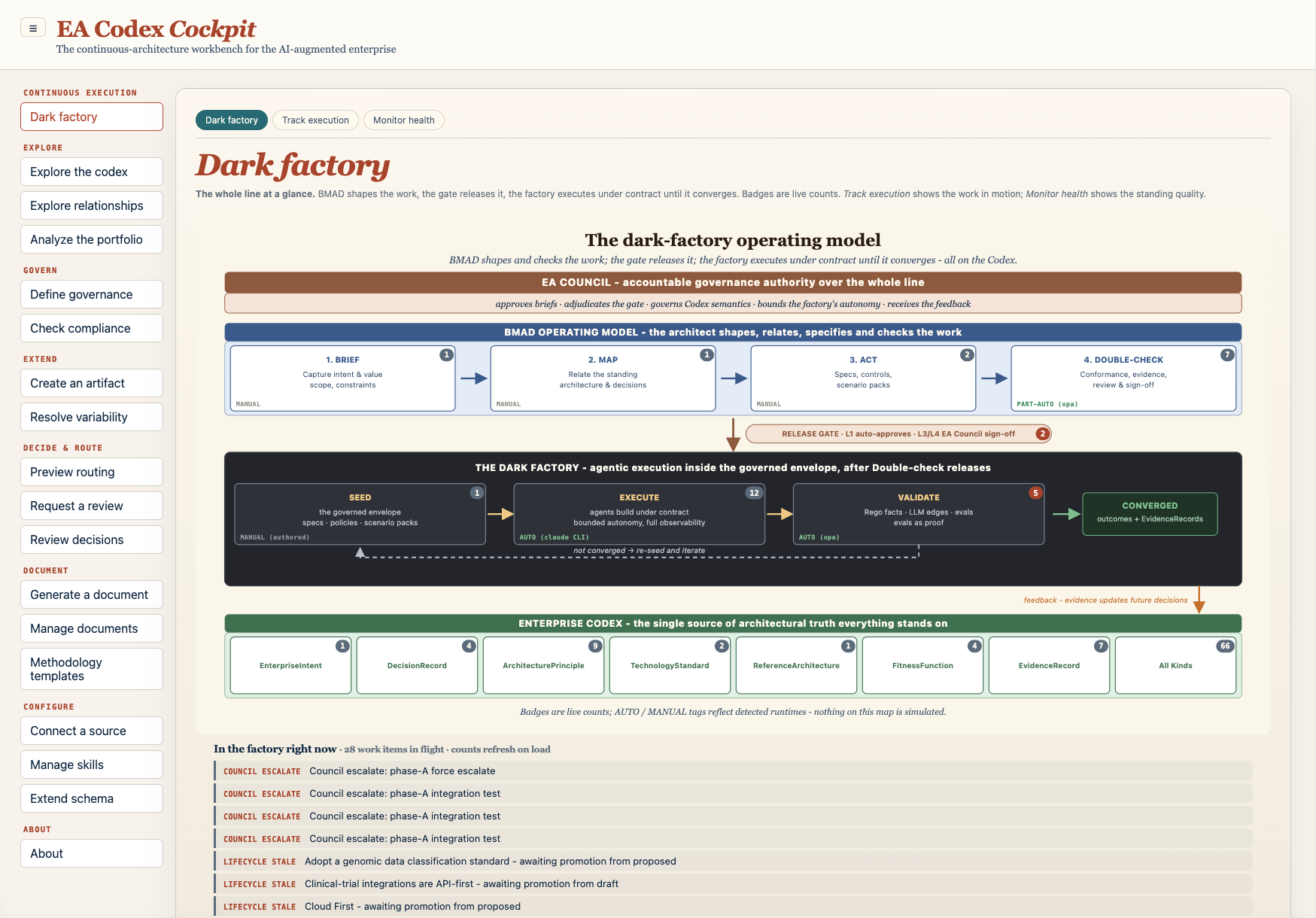
The dark-factory operating model
Once intent, policies, standards, constraints, controls, and contracts are codified, agents no longer start from a blank page.
1. BMAD operating model
Every artifact moves through Brief, Map, Act, and Double-check, instead of a document that quietly goes stale. The Cockpit scaffolds the brief, seeds the spec from a methodology template, generates enforcement policy, and routes the change for review.
2. The Architecture Council
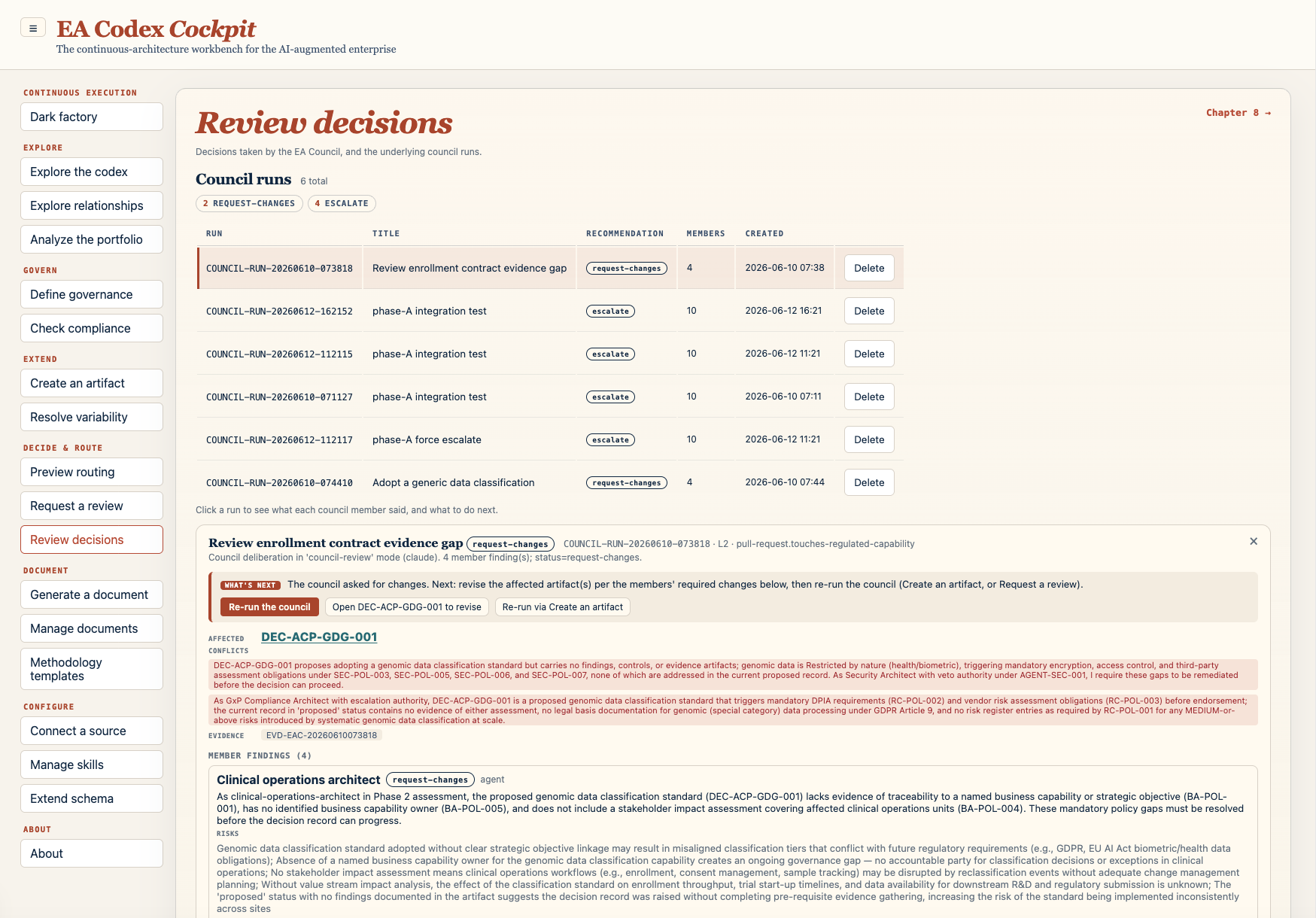
An AI design-authority body of ten specialist agents, each evaluating a proposal through a different architectural lens, contributes to a collective assessment of risks, trade-offs, constraints, and opportunities before a change proceeds.
3. The dark factory
Inside the governed envelope defined by the Codex, agents generate specifications, perform analyses, execute validations, collect evidence, and iterate until convergence. Approved work flows as typed packets once the council clears it.
4. The Enterprise Codex
The standing source of architectural truth everything refers back to: principles, standards, reference architectures, decisions, and controls, all as typed Codex kinds with traceable relationships.
What it does today
A few things implemented so far in the preview.
One knowledge graph for everything
Codex artifacts (principles, standards, controls, decisions) and the live IT landscape (applications, data, interfaces, capabilities) in a single picture. The view adapts to your source: CSV, Excel, EA-as-Code, or LeanIX over MCP, read live with nothing copied. Click any node to see its impact across governance and reality.
Continuous execution as a Kanban
Work moves through BMAD (Brief, Map, Act, Double-check) rather than a document that quietly goes stale, so architecture keeps pace with delivery.
Governance you can run
Define principles, standards, fitness functions, and policies, then check any object, whether a Codex artifact or a real application, for conformance.
Create with AI, govern with a council
A guided wizard drafts the artifact (intent, spec, controls) and validates it against the schema, then routes it to the EA Design Authority. The council deliberates and returns approve, request-changes, or escalate, with an evidence record and a draft decision.
Three scopes that match how change happens
Enterprise, initiative, and capability. Every read lens and analysis inherits the scope in focus, so the picture stays relevant to the decision at hand.
Data management, made real
A first implementation of Chapter 11: a Business Object is materialized by Data Products, each constrained by Data Contracts and served to consumers.
The boring-but-essential
Portfolio analytics, lifecycle health, and one-click PDF and Word documents generated from typed data, so governance produces deliverables rather than slideware.
Architectural reasoning, made explicit
The objective of the council is not to automate governance but to make architectural reasoning more explicit, traceable, and consistent across the security, data, cloud, integration, compliance, platform, and business perspectives that read the same situation differently.
An early research preview.
The Cockpit is under active development and is not open source. This page is a preview of the work done to realize the EA Codex vision; the early results suggest a very different way of practicing enterprise architecture, and the capabilities continue to evolve.