What the chapter covers
14 sections, in order.
- 18.1 The three Codex scenarios as the structural lens
- 18.2 The six-layer chain
- 18.3 Method & Operating Model (Layer 1)
- 18.4 Execution Capabilities (Layer 2)
- 18.5 Enterprise Codex (Layer 3)
- 18.6 Control Tower (Layer 4)
- 18.7 Delivery & Runtime (Layer 5)
- 18.8 Layer 6 — Feedback & Evidence
- 18.9 Cross-cutting — AI agents and the EA Council
- 18.10 ACME Pharma in Scenario 3
- 18.11 What architects should take
- 18.12 Risks, limits, and trade-offs
- 18.13 Conclusion
- 18.14 Sources
Figures, tables and listings
1 figure · 7 tables
Reproduced in full, in the order they appear in the published chapter. The reasoning that connects them is in the book.
| # | Layer | What it answers | Chain step |
|---|---|---|---|
| 1 | Method & Operating Model | How is the architecture function organized? | Brief / Map (BMAD) |
| 2 | Execution Capabilities | How do we produce artifacts? | Map / Act |
| 3 | Enterprise Codex | What are the typed objects? | Specification |
| 4 | Control Tower | Where does the architectural truth live? | Specification → Execution |
| 5 | Delivery & Runtime Ecosystem | How do we enforce? | Execution |
| 6 | Feedback & Evidence Loop | How do we know it worked? | Feedback |
Figure 18.1: The six-layer reference stack and the question each layer answers.
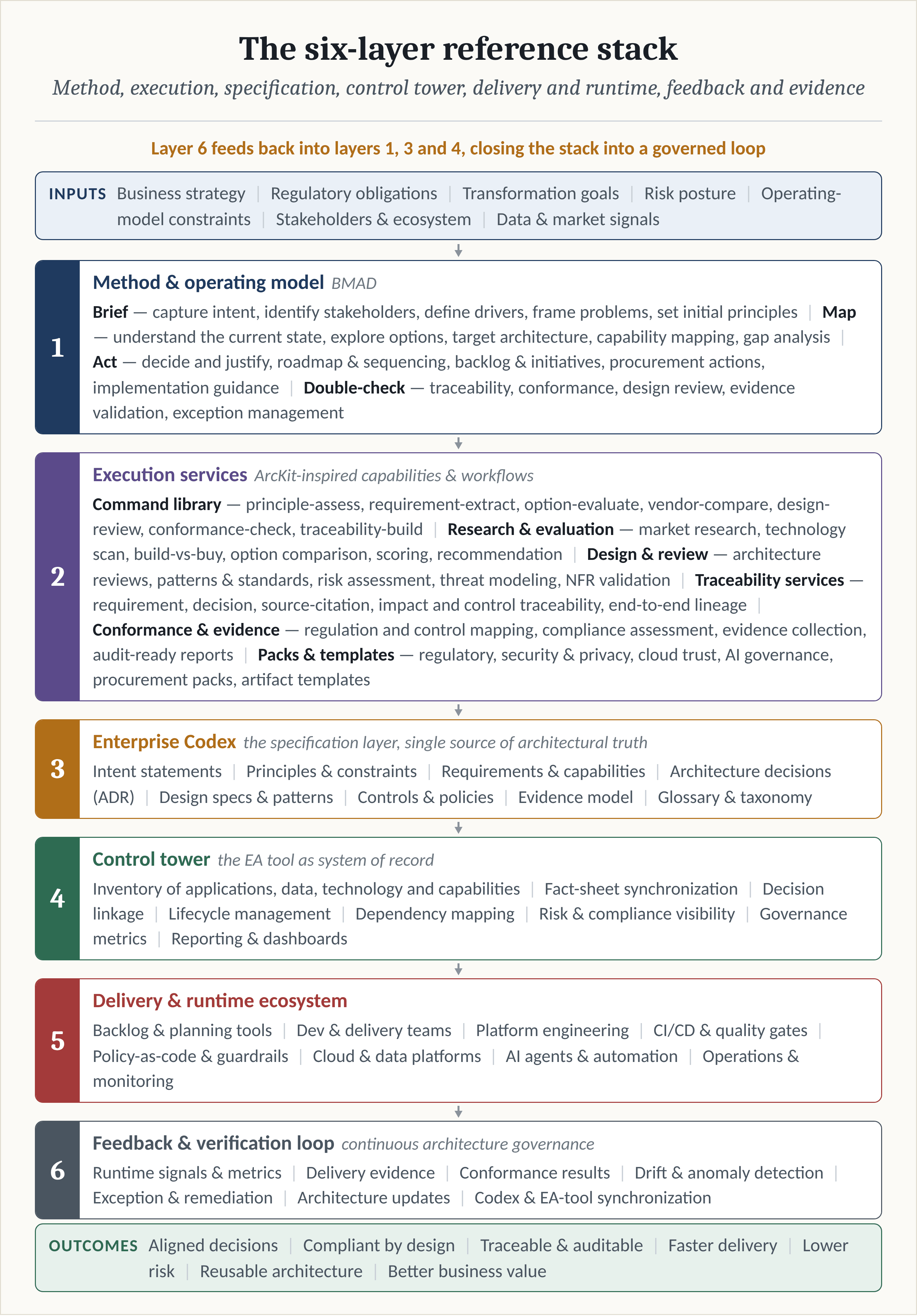
Figure 18.2: The six-layer reference stack: method, execution, specification, control tower, delivery and runtime, feedback and evidence.
| Solution | Type | What it does | Primary source |
|---|---|---|---|
| BMAD operating flow | Open (book) | Brief, Map, Act, Double-check as the architect's flow | Chapter 7 |
| Continuous Architecture Framework | Open (book) | Six principles for continuous-delivery-era architecture | https://continuousarchitecture.com/the-book/ |
| Continuous Architecture Toolkit | Open source | Practices and templates in production at Michelin, Gluendo, DXC, Société Générale, France Travail, Thales | https://github.com/continuous-architecture/toolkit |
| TOGAF ADM | Standard | Architecture Development Method | https://www.opengroup.org/togaf |
| IASA BTABoK | Open framework | Business Technology Architecture Body of Knowledge | https://iasa-global.github.io/btabok/ |
| EA Council (book's own concept) | Method + governance pattern | Standing institutional authority that owns the Codex | Chapter 4 + Chapter 6; companion knowledge base at https://github.com/ruudoverbeek1/ea-council-knowledge |
Figure 18.3: Layer 1 — Method & Operating Model: solutions and primary sources.
| Solution | Type | What it does | Primary source |
|---|---|---|---|
| ArcKit | Open source | 125 slash commands for Claude Code, Gemini CLI, Codex CLI, OpenCode, Copilot; drafts governance artefacts | https://arckit.org/ + https://github.com/tractorjuice/arc-kit |
| Microsoft Architecture Review Agent | Open source sample | FastAPI+React service that ingests architecture docs and returns review + Excalidraw diagram | https://github.com/Azure-Samples/agent-architecture-review-sample |
| ArchLens Enterprise Intelligence | Commercial | Commercial AI-overlay pattern over EAM repositories; detailed portfolio-intelligence claims should be treated as vendor-claimed | https://archlens-app.web.app/ |
| EA tool | Commercial | AI guidance embedded inside the EA tool (Scenario 1 fit) | SAP LeanIX AI Agent Hub announcement or Ardoq AI roundup |
Figure 18.4: Layer 2 — Execution Capabilities: AI-assisted artefact production and review tools.
| Solution | Type | What it does | Primary source |
|---|---|---|---|
| FINOS CALM | Open standard | JSON Schema-based architecture description; CLI runs in CI; v1.0 from Morgan Stanley contribution, August 2025 | https://github.com/finos/architecture-as-code + https://calm.finos.org/ |
| EA Codex (ea.codex/v1) | Open schema | Typed enterprise memory (intent, decisions, controls, agent contracts, sovereignty, data products, evidence) | https://github.com/welkaim/ea-codex |
| CoDL (Concept Definition Language) | Open (IASA BTABoK) | Canvas-style concept definitions (capabilities, decisions, business cases) generated by the Metis Loom tool and fed into AI context harnesses; CaDL is an exploratory companion | education.iasaglobal.org BTABoK 3.2 + Paul Preiss announcement |
| Structurizr DSL | Open | Models-as-code DSL based on the C4 model (Simon Brown) | https://structurizr.com/dsl |
Figure 18.5: Layer 3 — Enterprise Codex: typed architecture artefact formats.
| Scenario | Primary surface | Examples | Custom integration |
|---|---|---|---|
| 1 — EA tool absorbs Codex | Commercial EA platform | SAP LeanIX (with AI Guidance and MCP server); Ardoq (with MCP) | Export of fact sheets for L5 enforcement |
| 2 — Codex absorbs EA tool | Git repository / data platform | EA-as-Code (Paul Stean); Peaqview; Databricks/Snowflake + Neo4j; ArcKit + Git | None at L3/L5 — Git-native |
| 3 — Compose | EA platform + Git repository | Any commercial EA tool + Git Codex repo + MCP bridge | MCP bridge between tool and Git; EvidenceRecord aggregator |
Figure 18.6: Layer 4 — Control Tower / Record: scenarios, examples, and custom integration boundaries.
| Solution | Type | What it does | Primary source |
|---|---|---|---|
| OPA + Rego + Conftest | Open source (CNCF graduated) | Vendor-neutral policy engine; validates any JSON/YAML input; runs in CI through Conftest | https://www.openpolicyagent.org/ + https://github.com/open-policy-agent/conftest |
| ArchUnit family | Open source | Per-language code-structure tests (ArchUnit, NetArchTest, PyTestArch, arch-go) | https://www.archunit.org/ |
| Crossplane | Open source (CNCF) | Kubernetes-based platform-API composition | https://www.crossplane.io/ |
Figure 18.7: Layer 5 — Delivery & Runtime: enforcement and platform-automation tools.
| Solution | Type | What it does | Primary source |
|---|---|---|---|
| DORA metrics | Open methodology | Four delivery keys (lead time, deploy frequency, MTTR, change failure rate) | https://dora.dev/ |
| ArchLens (academic) | Open source | Code-structure drift detection: CLI, VS Code, GitHub workflow | https://mircealungu.com/projects/ArchLens.html + https://github.com/archlens/ArchLens |
| ArchLens Enterprise Intelligence | Commercial | Vendor-claimed portfolio intelligence: regulatory readiness, CVE blast-radius analysis, TIME automation, vendor rationalization | https://archlens-app.web.app/ |
| NIST AI RMF / ISO 42001 / EU AI Act / EU DORA | Standards | Define what evidence must look like | https://www.nist.gov/itl/ai-risk-management-framework + https://www.iso.org/standard/81230.html + https://eur-lex.europa.eu/eli/reg/2024/1689/oj + https://eur-lex.europa.eu/eli/reg/2022/2554/oj |
Figure 18.8: Layer 6 — Feedback & Evidence: telemetry, drift detection, and regulatory anchors.